The Galleria degli Uffizi on Piazzale degli Uffizi in Florence, Italy, holds the world’s greatest collection of Italian Renaissance painting and one of the most important collections of Western art.
This guide was updated in June 2026. Three pricing tiers now apply — most guides only mention one. The standard on-day ticket is €25, the advance ticket is €29, and a new afternoon ticket (entry from 16:00) costs €16 on-day — a discount introduced from 1 January 2026 that most guides have not yet reflected. Separately, the Botticelli Rooms are undergoing refurbishment works, confirmed on the official notices page. You can book through GetYourGuide in advance.
Quick facts
| Detail | Information |
|---|---|
| Address | Piazzale degli Uffizi 6, 50122 Florence, Tuscany. |
| Hours | Tuesday–Sunday, 08:15–18:30 |
| Closed | Mondays; 1 January; 25 December |
| Ticket office closes | 17:30 |
| Standard on-day ticket | €25 |
| Standard advance ticket | €29 |
| Afternoon on-day ticket (entry from 16:00) | €16 |
| Afternoon advance ticket (entry from 16:00) | €20 |
| Prima Mattina ticket (entry 08:15–08:55 only) | €19 on-day (limited slots) |
| Reduced (EU citizens 18–25) | €2 |
| Under 18 | Free |
| Groups of 11+ extra fee | €70 per group |
| PassePartout 5 days (Uffizi + Pitti + Boboli) | €40 |
| Annual pass (Uffizi + Pitti + Boboli) | €80 (one person); €120 (family) |
| Audioguide | €6 (Italian, English, French, Spanish, German, Polish, Russian, Japanese) |
| Access ramp | Via della Ninna |
| Typical visit | 2–3 hours (highlights); 3–5 hours (full collection) |
Uffizi Gallery opening hours
The Uffizi is open Tuesday to Sunday, 08:15 to 18:30. It is closed on Mondays, 1 January, and 25 December. The ticket office closes at 17:30 — one hour before the museum closes. Arriving at 17:30 means the last ticket is being sold at that moment; the Uffizi’s own guidance asks visitors to begin leaving at 18:30. Allow at least two hours from entry to see the essential rooms.
Check the official Uffizi website for extraordinary openings. In 2026, the gallery opened exceptionally on Monday 1 June with regular hours — exceptional Monday openings of this type are announced via the notices page.
Uffizi Gallery admission prices
Three pricing tiers apply from 1 January 2026 — the full picture is absent from most travel guides.
| Ticket | On-day (door) | Advance |
|---|---|---|
| Standard (any time up to 16:00) | €25 | €29 |
| Afternoon (entry from 16:00) | €16 | €20 |
| Prima Mattina (entry 08:15–08:55 only) | €19 | — |
| Reduced (EU citizens 18–25) | €2 | €2 |
| Under 18 | Free | Free |
| PassePartout 5 days (Uffizi + Pitti + Boboli) | €40 | — |
| Groups of 11+ extra fee | €70 | — |
| Annual pass (one person) | €80 | — |
The Prima Mattina ticket (€19, first two slots of the day: 08:15–08:55) is the cheapest full-gallery ticket and lands visitors in the Botticelli rooms before tour groups arrive. Available only at the official Uffizi ticket platform, with a limited daily quota. The afternoon discount (€16 on-day) gives approximately 2.5 hours of visiting time. Free admission applies on the first Sunday of the month. Book in advance through GetYourGuide for a confirmed time slot.
Why visit the Uffizi Gallery?
- 🎨 The world’s greatest concentration of Renaissance painting: Botticelli’s Birth of Venus and Primavera, Leonardo’s Annunciation, Michelangelo’s Doni Tondo, and Caravaggio’s Medusa are all here — in a single building.
- 🎟️ Afternoon discount from 16:00: Entry from 4pm costs €16 on the day (€20 in advance) — a discount introduced from 1 January 2026. The galleries are noticeably quieter at this hour and 2.5 hours is sufficient for the key rooms.
- 🌿 The panoramic terrace is free with your ticket: The second-floor cafeteria has an outdoor terrace overlooking Piazza della Signoria and Palazzo Vecchio. It is one of the finest elevated views in Florence and is included in standard admission.
- 📜 Magnifico 1492 (autumn 2026): A major upcoming temporary exhibition on Lorenzo de’ Medici, reconstructing the collection inventoried at his death. Confirm exact dates and ticket inclusion on the official Uffizi site closer to your visit.
- 💰 Prima Mattina: the cheapest full-gallery entry: The first two time slots (08:15–08:55) cost €19 on-day — €6 less than the standard on-day price. Limited daily quota; only available at the official Uffizi ticket platform.
How to get to the Uffizi Gallery
On foot from the Duomo, the Uffizi is an 8-minute walk south along Via dei Calzaiuoli to Piazza della Signoria, then through the Piazzale degli Uffizi. From the Ponte Vecchio it is a 3-minute walk north.
By bus, the ATAF C1 bus connects the Uffizi with the Oltrarno and Santa Croce. Bus C2 connects with Stazione SMN. The ZTL means buses cannot enter the heart of the historic centre by car. The Uffizi is most practically reached on foot from anywhere in central Florence — no point of interest in the historic centre is more than 20 minutes’ walk.
By car, ZTL restrictions cover the entire historic centre. Use car parks at Piazza della Stazione (SMN) or Fortezza da Basso, both outside the restricted zone, then walk approximately 20 minutes.
5 great Florence experiences to book
- 🏛️ Cover Florence in a day – including the Duomo, Uffizi and skip-the-line tickets for Michelangelo’s David.
- 🍝 Learn how to make pasta the Tuscan way at a cooking class with unlimited wine.
- 🎨 On a guided tour of the Uffizi Gallery, discover the detail in the Renaissance masterpieces.
- 🗿 Discover much more than David on a guided tour of the Galleria dell’Accademia.
- 🍷 Take a 4WD Tuscan wine safari – with several winery tastings and a three-course lunch.
Parking at the Uffizi Gallery
No parking exists at or near the Uffizi — the Piazzale degli Uffizi is fully pedestrianised. ZTL restrictions apply across the historic centre. Car parks outside the ZTL at Santa Maria Novella station and Fortezza da Basso are the nearest options. Given Florence’s geography, walking from any of the historic centre’s accommodation is almost always practical.
How long to spend at the Uffizi Gallery
The Uffizi holds 45 rooms across two floors. A highlights visit — Botticelli, Leonardo, Michelangelo, Raphael, Titian, and Caravaggio — takes 2 to 3 hours at a purposeful pace. A more comprehensive visit across the full collection, including the Gothic rooms, Northern European masters, and late-period works, requires 4 to 5 hours and is rarely done in a single session. The gallery’s PDF map (downloadable at uffizi.it) includes a suggested highlights route. The afternoon ticket (entry from 16:00) gives approximately 2 hours and 15 minutes — enough for the essential rooms if you follow a focused route.
Accessibility at the Uffizi Gallery
An access ramp is available from Via della Ninna — the main Piazzale degli Uffizi entrance involves steps. Lifts are located at the end of the visit route on both floors. Note a specific guidance from the official site: lifts in the east wing of the Uffizi are not accessible for all wheelchair types — confirm before visiting if your chair has specific dimensions. Wheelchairs with a combined weight (chair + person) of more than 230 kg or a length of more than 120 cm are not admitted. If an alternative entrance is needed, reception staff can assist.
A baby pit-stop room is near the cafeteria. Accessible toilets are on all floors. The cloakroom (free) is immediately after the Eastern colonnade entrance; umbrellas and large bags must be left there. The audioguide (€6) is available from the entrance on presentation of ID.
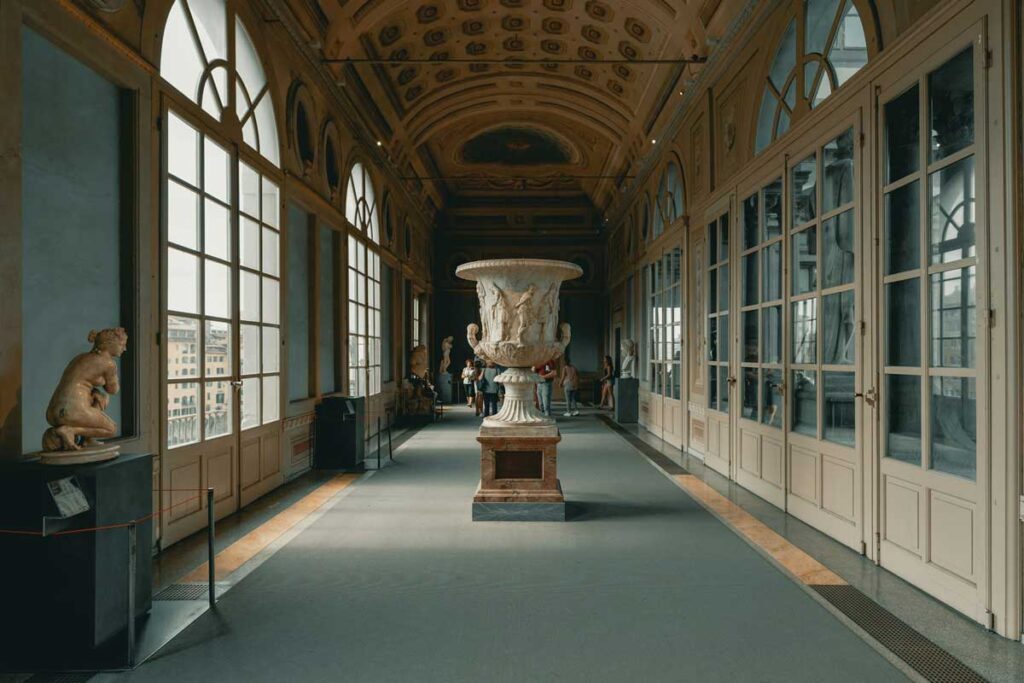
What to see at the Uffizi Gallery
The Botticelli Rooms (Rooms 10–14) are the emotional centre of the museum. The Birth of Venus (c.1484–1486) and Primavera (c.1477–1482) are displayed in the same room — two of the most studied paintings in Western art, and the principal reason most visitors come. The Botticelli Rooms are currently undergoing refurbishment works, confirmed on the official Uffizi notices page — check the current status before visiting, as specific sections may be partially inaccessible.
The Leonardo da Vinci room (Room 35) holds the Annunciation (c.1472–1475) — painted when Leonardo was approximately 20 years old — and the unfinished Adoration of the Magi (1481–1482). Seen together, the two works span nearly a decade of a young artist developing a completely new approach to figuration.
Michelangelo’s Doni Tondo (Room 35) is the only finished panel painting by Michelangelo and the work he considered his greatest achievement in the medium. The compressed energy of the figures and the unresolved background nudes have fascinated scholars and painters since 1507.
The Raphael and Michelangelo room (Room 66) contains Raphael’s Portrait of Leo X with Two Cardinals (1518–1519) — the most important papal portrait of the Renaissance — alongside works from both artists’ Florentine periods.
The Caravaggio rooms (Rooms 90–93) contain the Medusa (a painted shield, c.1597) and Sacrifice of Isaac (1601–1602). The Medusa is the most reproduced early Caravaggio in any collection.
The first-floor corridor windows at the east end look through Ponte Vecchio’s central gap across the Arno — a view available from nowhere else in Florence, and the only trace visible to standard visitors of the private passage Cosimo I built to connect his two palaces.
Practical tips for visiting the Uffizi Gallery
| Tip | Detail |
|---|---|
| Three price tiers exist | On-day standard €25; advance €29; afternoon (16:00+) €16 on-day, €20 advance; Prima Mattina (08:15–08:55) €19. Most guides only mention one or two of these. |
| Afternoon entry from €16 | Entry after 16:00 costs €16 at the door (introduced 1 January 2026). The galleries are significantly less crowded and 2.5 hours is enough for the key rooms with a focused route. |
| The Botticelli Rooms are under refurbishment | Confirmed on the Uffizi notices page. Check the current situation before visiting — specific display cases or areas may be affected. |
| Ticket office closes at 17:30, not 18:30 | The museum closes at 18:30 but the ticket office closes at 17:30. Arriving after 17:30 means no ticket. |
| Book in advance | Essential in summer. Walk-up queues can exceed 2 hours in July and August. Pre-booking guarantees your slot and, for the afternoon ticket, locks in the lower price. |
Uffizi Gallery FAQ
| Question | Answer |
|---|---|
| How much is a standard ticket? | €25 at the door on the day; €29 if pre-booked. The afternoon ticket (entry from 16:00) costs €16 on-day or €20 in advance — introduced 1 January 2026, absent from many guides. |
| Are the Botticelli Rooms open? | Partially — refurbishment works are confirmed on the official notices page. Check uffizi.it for current room availability before your visit. |
| What is the Prima Mattina ticket? | An on-day ticket (€19) for the first two time slots (08:15–08:55 AM). It is the cheapest full-gallery entry and puts you in the Botticelli rooms before tour groups. Limited daily quota; available only at the official Uffizi platform. |
| What time does the ticket office close? | 17:30 — one hour before the museum closes at 18:30. Arriving at 17:45 means no admission. |
| Is the Vasari Corridor open? | The Corridor has limited access with a separate supplement (€20 single entry on top of the museum ticket). Check current availability on the official Uffizi site. |
Things to do near the Uffizi Gallery
The Piazzale degli Uffizi and Piazza della Signoria frame the museum entrance. The Loggia dei Lanzi at the north-east corner of the Signoria is a permanent outdoor sculpture gallery with Cellini’s Perseus and Giambologna’s Rape of the Sabine Women — free to view at any time.
Ponte Vecchio is a 3-minute walk west. The medieval bridge is lined with goldsmiths since Ferdinando I’s decree of 1593 and provides the best view of the Arno from street level.
The Bargello National Museum is an 8-minute walk north-east and holds Donatello’s two Davids, Michelangelo’s Bacchus, and the world’s greatest collection of Italian Renaissance sculpture. The Bargello complements the Uffizi’s painting focus with an equally important sculptural counterpart.
The Galileo Museum (Museo Galileo) is a 5-minute walk east along the Arno and holds the world’s largest collection of scientific instruments from the Medici collections — including Galileo’s original telescopes and a relic of his middle finger. Often missed by visitors focused on art.
The Corridoio Vasariano connects the Uffizi to Palazzo Pitti via Ponte Vecchio in an elevated private corridor. A separate supplement (€20) applies. The corridor hangs hundreds of artists’ self-portraits; booking is required and slots are limited.
Similar art galleries to visit near Florence
The Accademia Gallery, Florence holds Michelangelo’s David in the purpose-built Tribune and the four unfinished Prisoners. Around 20 minutes’ walk north from the Uffizi. Advance booking is essential year-round; queues without a reservation can exceed 90 minutes.
Palatine Gallery (Pitti Palace), Florence holds the Medici’s personal painting collection in its domestic hang — Raphael, Titian, Rubens, and Caravaggio in crowded gilt frames exactly as the Grand Dukes lived with them. 10 minutes’ walk west over the Ponte Vecchio.
Museo Civico and Pinacoteca, Siena holds Simone Martini’s Maestà and a major collection of Sienese Gothic painting — the closest stylistic counterpart to the Uffizi’s pre-Renaissance rooms. Around 90 minutes south by car.
Borghese Gallery, Rome holds the world’s largest Bernini sculpture collection alongside Raphael, Titian, and Caravaggio. Limited to 360 visitors per two-hour slot; advance booking is mandatory. Around 3 hours south of Florence by high-speed train.
Pinacoteca di Brera, Milan is the principal art museum of Lombardy and holds major works by Mantegna, Piero della Francesca, and Raphael — including The Dead Christ and The Marriage of the Virgin. Around 2 hours north of Florence by high-speed train.
More Tuscany travel
Other Tuscany travel guides on Planet Whitley include:
- Why do hot air balloon flights in Tuscany leave so early?
- How to visit two Chianti Classico wineries from Florence in one afternoon.
- Learning to make pasta in Florence.
- How long are the queues to see Michelangelo’s David?
- Florence attraction guides: Basilica of Santa Maria Novella, Palazzo Vecchio, Bargello Museum, Medici Chapels, Museo de Medici, Galleria dell’Accademia, Museo Galileo, Florence Synagogue and Museum, Pitti Palace and Boboli Gardens.