The History of Science Museum is a free museum at Broad Street, Oxford, housed in the world’s oldest surviving purpose-built public museum building (built 1683). It holds one of the world’s greatest collections of historic scientific instruments. This guide covers opening hours, admission, transport, parking, accessibility, what to see, and practical tips for planning your visit.
My personal Oxford recommendation
Oxford is a city of stories. You miss a lot of the walking around independently. This is a place where, much more than usual, it’s worth taking a walking tour.
I took the excellent Official Oxford University and City walking tour. It gave a great grounding on the city’s history, quirky university traditions and fascinating details on buildings you may otherwise miss. I recommend it, but there are other Oxford walking tours to choose from if you’d prefer a different theme.
Last updated: June 2026. This guide is based on the official History of Science Museum plan-your-visit page (University of Oxford). Note that the museum lift is currently out of action, meaning level access to the Basement Gallery is not available. This is a live notice on the official website. Additionally, a frequently confused detail: the museum opens at 10am, not 12pm — an error that appears on some older group-booking pages and third-party sources.
Quick facts
| Detail | Information |
|---|---|
| Address | Broad Street, Oxford, Oxfordshire, OX1 3AZ |
| Opening hours | Tuesday–Sunday, 10:00am–5:00pm; last admission 4:50pm |
| Closed | Mondays (except for pre-booked educational visits) |
| Entry price | Free; donations welcome |
| Nearest transport | Oxford station (~15 min walk); bus station (~10 min walk) |
| Parking | No on-site parking; Park & Ride recommended |
| Toilets | None in the museum |
| Typical visit length | 1–2 hours |
History of Science Museum opening hours
The museum is open Tuesday through Sunday, 10:00am to 5:00pm. Last admission is at 4:50pm. It is closed on Mondays (educational group visits by pre-arrangement only).
There are no seasonal variations to these hours. The museum may occasionally close for special events — check the official website if your visit date is time-sensitive.
Opening hours and admission were checked on the official History of Science Museum website and last updated in June 2026.
5 Oxford experiences worth booking
- 🎓 Take an Oxford University walking tour led by an alumni guide.
- ⚡ Explore Oxford’s Harry Potter filming locations on a tour including New College.
- 🚣 Embark on a scenic river cruise along the University Regatta course.
- 🕵️ Discover the Oxford of Morse, Lewis and Endeavour on a themed walking tour.
- 🏰 Hear dark historic tales on a guided visit to Oxford Castle and Prison.
History of Science Museum ticket prices
General admission is free. No booking is required for individual and family visitors. Donations are welcomed.
Groups (including self-guided groups) must book in advance via the visiting-group page on the museum’s website. There is no walk-in access for groups.
The museum is not included in any commercial city pass scheme. It is part of the University of Oxford’s Gardens, Libraries and Museums (GLAM) group.
How to get to the History of Science Museum
The museum is on Broad Street in the centre of Oxford, directly next to the Sheldonian Theatre.
By train: Oxford station is approximately 15 minutes’ walk. Taxis and buses are available from the station forecourt.
By coach/bus: The main Oxford bus station is approximately 10 minutes’ walk from Broad Street. National Express coaches also use Gloucester Green, adjacent to the bus station.
By Park & Ride: Five Park & Ride sites on the main roads into Oxford provide frequent buses to the city centre. This is the recommended option for visitors arriving by car.
By bike: Oxford is well served by cycle routes. Cycle parking is available near Broad Street.
Parking at the History of Science Museum
There is no parking at the museum. Central Oxford parking is very limited during the day. The Park & Ride network is the recommended option. The main city-centre car and coach park is on Oxpens Road. Pay-and-display parking is available on some nearby streets (Broad Street, Mansfield Road, Blackhall Road) but fills quickly. Check the Oxford City Council website for all current options.
Coaches may drop off and pick up on Broad Street. Groups travelling by minibus are advised to use the Park & Ride.
How long to spend at the History of Science Museum
Allow 1 to 2 hours for a thorough visit. The museum occupies three floors of a compact historic building. Visitors with a strong interest in the history of science, instrument-making, or scientific history may find a full two hours passes quickly. Those who attend a programme event or ‘How Does It Work’ demonstration should allow additional time.
Accessibility at the History of Science Museum
IMPORTANT — LIFT CURRENTLY OUT OF ACTION: The museum’s lift, which provides level access to the Basement Gallery only, is temporarily not in service (as confirmed on the official website at the time of writing). This means level access to the Basement is not currently available. Please ask museum staff for assistance on arrival.
The Ground Floor and Top Gallery require use of stairs. The museum building is historic (1683) and cannot be fully adapted to modern accessibility standards. A detailed Access Guide is available at accessguide.ox.ac.uk/history-science-museum-0.
There are no public toilets in the museum. The nearest public toilets are in the Westgate Shopping Centre (~5 minutes’ walk) and the Covered Market (~5 minutes’ walk).
For accessibility queries before visiting, contact the museum at info@hsm.ox.ac.uk or 01865 277293. Relaxed openings for neurodivergent and SEND visitors are offered periodically — check the events calendar for dates. A free Easy Read Guide is available to download from the museum’s website.
What to see at the History of Science Museum
The building
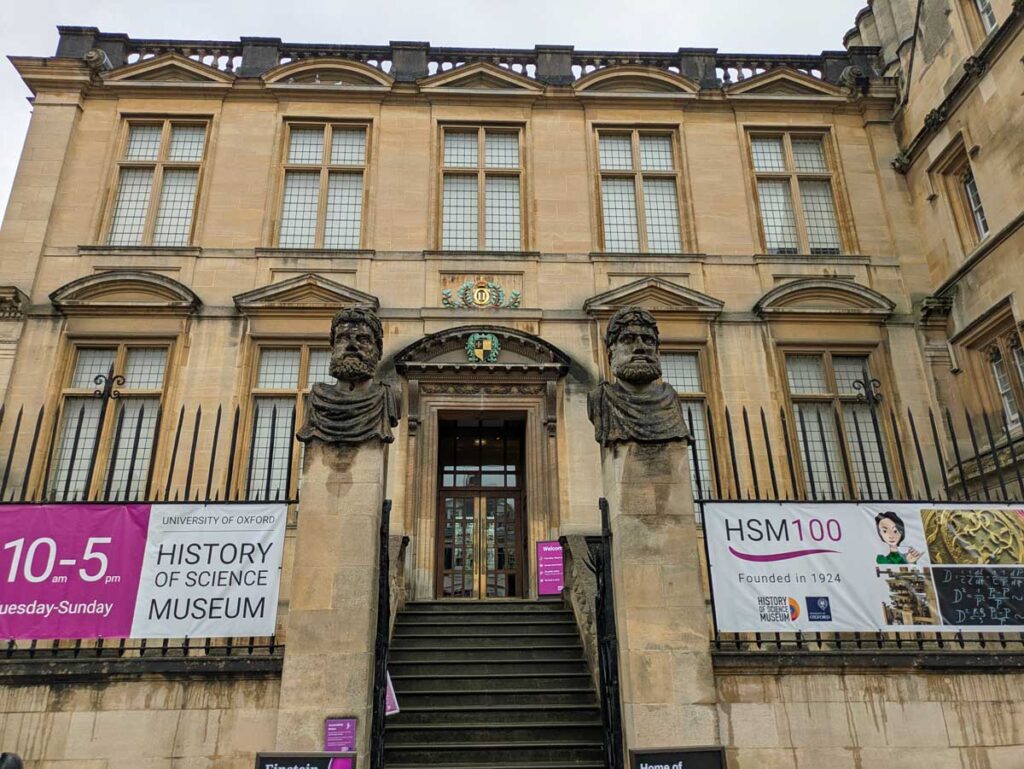
The museum occupies the Old Ashmolean Building, constructed in 1683 to house Elias Ashmole’s collection — making it the oldest surviving purpose-built public museum building in the world. It pre-dates the current Ashmolean Museum on Beaumont Street by over 200 years. The building originally also housed a chemical laboratory in the basement and a lecture room on the middle floor. It is a listed building of considerable architectural and historical significance in its own right.
The collection: overview
The museum holds around 20,000 objects covering almost every aspect of the history of science from ancient to modern times, with particular strength in the following areas:
Astrolabes — the museum’s astrolabe collection is one of the finest in the world, with instruments from medieval Islamic, European, and Asian traditions. A dedicated online catalogue is available at mhs.ox.ac.uk/astrolabe.
Sundials — an internationally significant collection spanning many centuries and cultures.
Mathematical instruments — drawing instruments, calculating devices, and surveying equipment spanning a thousand years of mathematical practice.
Astronomical instruments — telescopes, orreries, armillary spheres, and related equipment, including instruments from the history of Oxford’s own astronomical tradition.
Chemical apparatus — laboratory equipment from the 17th to 19th centuries, reflecting the museum’s origins in Ashmole’s collection and Oxford’s early chemical science.
Early photography — a collection of photographic equipment and images from the 19th century.
Microscopes and optical instruments — from early compound microscopes to precision optical devices.
Gallery highlights
Top Gallery — the uppermost floor, with the museum’s most visually striking objects including large armillary spheres and celestial globes. The gallery provides an overview of navigational, astronomical, and mathematical instruments across multiple cultures.
Ground Floor Gallery — the main entrance level, with the Lewis Evans collection of sundials (among the largest in the world) and rotating thematic displays.
Basement Gallery — currently accessible via stairs only (lift out of order). Houses the chemical and photographic collections, early microscopes, and the famous blackboard used by Albert Einstein during a 1931 Oxford lecture — still bearing equations written in his hand.
The Einstein Blackboard
The Einstein Blackboard in the Basement Gallery is one of the museum’s most visited objects. Albert Einstein used it during a lecture at Oxford in May 1931; it was preserved after the lecture and has been in the museum’s collection ever since. It shows equations relating to the expanding universe. Note that the lift is currently out of action — reach the Basement by stairs or ask staff for assistance.
Programme events
The museum runs regular ‘How Does It Work’ afternoons where visitors can handle objects from the collection and see instruments demonstrated. Light and Space family backpacks are available for free loan. Relaxed openings for neurodivergent visitors run periodically. Check the What’s On calendar at hsm.ox.ac.uk for current event dates.
A Museum of Climate Hope Digital Trail runs across Oxford’s GLAM institutions, including the History of Science Museum — suitable for families and school groups.
Practical visitor tips
| Tip | Detail |
|---|---|
| The lift is currently out of order | Level access to the Basement Gallery is not available. Ask staff on arrival for assistance with stairs. |
| No toilets in the building | There are no public toilets in the museum. Use facilities in the Westgate Shopping Centre or Covered Market before or after your visit. |
| The museum opens at 10am, not 12pm | Some older sources and the group bookings page state 12pm — this applies to public hours stated on some older pages. The main plan-your-visit page confirms 10am. |
| Groups must pre-book | All groups, including self-guided ones, must book in advance. Walk-in group access is not available. |
| Download the Easy Read Guide in advance | A visual guide to the museum’s layout is available to download and print from the official website. Useful for first-time visitors and those who benefit from pre-visit preparation. |
Frequently asked questions about the History of Science Museum
| Question | Answer |
|---|---|
| Is the History of Science Museum free? | Yes. General admission is free. Donations are welcome. Groups must pre-book but there is no charge for entry. |
| Is the museum open on Sundays? | Yes, Tuesday through Sunday, 10am–5pm. Closed on Mondays. |
| Is it suitable for children? | Yes. Free family backpacks (Light and Space), ‘How Does It Work’ sessions, and a junior gallery trail are available. Check the events calendar for current family activity dates. |
| Is the Einstein blackboard really there? | Yes. The blackboard Einstein used during his 1931 Oxford lecture is in the Basement Gallery, with equations written in his own hand. |
| Are there toilets? | No. There are no public toilets in the museum. The nearest are in the Westgate Shopping Centre (~5 minutes’ walk). |
Things to do near the History of Science Museum
- Sheldonian Theatre (directly adjacent) — Wren’s 1669 ceremonial hall for the University of Oxford, with a painted ceiling, historic attic, and cupola views over the city. Admission charged (£5.25–£14.50 depending on visit type). Check opening dates before visiting.
- Bodleian Library — Divinity School (~2 minutes’ walk) — The medieval Divinity School is one of Oxford’s finest 15th-century buildings, with a fan-vaulted ceiling. Public tours available (£3.50 adults). The Weston Library’s Blackwell Hall has free exhibitions.
- Ashmolean Museum (~5 minutes’ walk, Beaumont Street) — One of the world’s leading art and archaeology museums. Free admission; open Tuesday–Sunday.
- Museum of Natural History (~10 minutes’ walk, Parks Road) — Oxford’s natural history museum in a spectacular Victorian Gothic building. Free; open daily.
- Broad Street bookshops — Blackwell’s bookshop (No. 48–51) is two minutes from the museum and is one of the largest and most famous academic bookshops in the world.
What to visit tomorrow: similar museums of science history within two hours
- Science Museum, London (~60 miles southeast) — One of the world’s great science museums, covering the history of science, technology, and medicine across seven floors. Free general admission; some special exhibitions charged.
- Whipple Museum of the History of Science, Cambridge (~80 miles northeast) — A direct peer to the History of Science Museum, with a world-class collection of scientific instruments in a compact historic building. Free admission.
- Pitt Rivers Museum, Oxford (~12 minutes’ walk) — Accessed through the Museum of Natural History, one of the world’s greatest ethnographic collections in a remarkable Victorian display setting. Free admission.
More Oxfordshire travel
Other Oxfordshire travel articles on Planet Whitley include:
- 9 reasons to visit Oxford, England.
- Interact with great children’s literature at the Story Museum.
- Shudder at dark tales of incarceration at Oxford Castle and Prison.
- The quietest times to visit Blenheim Palace.
- Are dogs allowed inside Blenheim Palace?