Oxford is one of the most visited cities in England — and with good reason. The university’s collegiate architecture is extraordinary in its concentration and variety; the museums are genuinely world-class and almost entirely free to enter; and the layers of literary, scientific and political history compressed into a small, walkable city centre reward those who dig beyond the postcard imagery.
The Ashmolean is the oldest public museum in Britain; the Pitt Rivers is one of the most fascinating anthropological collections on earth; the Bodleian Library is among the great research libraries of the world; and a medieval tower, a Victorian bridge and a door in a college wall all carry literary significance that goes well beyond tourism.
These guides cover Oxford’s major attractions and landmarks with practical information on ticket prices, opening hours and what to look for on arrival. For a broader introduction to what makes the city worth visiting, nine compelling reasons to visit Oxford makes the case in full.
Oxford’s museums
Oxford’s museum offer is exceptional by any standard — six significant collections within easy walking distance of each other, almost all free to enter, covering natural history, world archaeology, art, the history of science, children’s literature and the city’s own story. A serious museum visitor could spend two or three full days in Oxford without running short of material.

- Ashmolean Museum, Oxford: ticket prices, opening hours and visitor guide — Britain’s oldest public museum, founded in 1683, with a permanent collection spanning Egyptian mummies, Greek and Roman antiquities, Renaissance paintings, Chinese ceramics and the lantern that Guy Fawkes allegedly carried on the night of the Gunpowder Plot — one of the great encyclopaedic collections in the world, and entirely free to enter.
- Pitt Rivers Museum, Oxford: ticket prices, hours and visitor guide — one of the world’s most remarkable anthropological and archaeological collections, entered through the back of the Museum of Natural History, with 500,000 objects packed into Victorian display cases organised by type rather than origin — shrunken heads, totem poles, amulets and ceremonial masks from every continent in an atmosphere unlike any other museum in Britain.
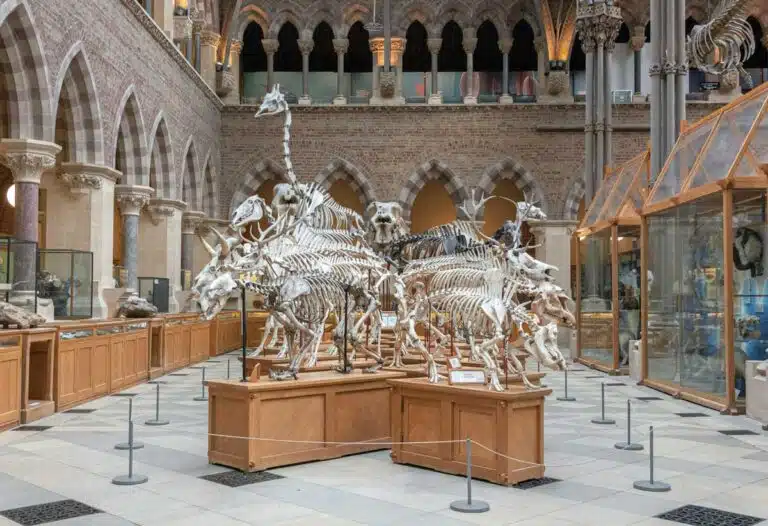
- Museum of Natural History, Oxford: ticket prices, hours and visitor guide — a breathtaking Victorian Gothic building with a cast-iron and glass roof sheltering dinosaur skeletons, the dodo specimen that inspired Alice in Wonderland and a mineralogy collection of extraordinary quality, free to enter and connected directly to the Pitt Rivers through an internal doorway.
- History of Science Museum, Oxford: practical visitor guide — housed in the Old Ashmolean Building on Broad Street, the oldest surviving purpose-built museum building in the world, with collections of astrolabes, sundials, early microscopes, Einstein’s blackboard and instruments that chart the history of scientific measurement across five centuries, all free to enter.
- Story Museum, Oxford: ticket prices, hours and visitor guide — a children’s literature museum in the heart of Oxford with immersive rooms dedicated to CS Lewis, Lewis Carroll, Philip Pullman and other authors with Oxford connections, combining storytelling, play and exhibition in a way that works for children and adults who grew up with these books.
- Museum of Oxford: a guide to the city’s own story — the museum that tells the history of Oxford the city rather than the university, covering the medieval market town, the Civil War siege, the car manufacturing era at Cowley and the lives of the residents who lived in the shadow of the colleges, free to enter and an essential counterweight to the university-dominated narrative of most Oxford visits.
The Bodleian Library and Oxford’s university buildings
The historic core of the University of Oxford — the area around Radcliffe Square, Broad Street and the Schools Quadrangle — contains some of the most architecturally significant buildings in England. Several are accessible only via the Bodleian Library’s guided and self-guided tours; others can be visited independently. These guides cover what each space contains and how to see it.
- Bodleian Library, Oxford: ticket prices, opening hours and visitor guide — one of the world’s great research libraries, holding over 13 million items and operating since 1602 as a legal deposit library entitled to a copy of every book published in Britain, with visitor access to the Divinity School, Duke Humfrey’s Library, Convocation House and the Radcliffe Camera through a range of tours and self-guided options.
- Divinity School, Oxford: visitor guide for Harry Potter fans and architecture lovers — the oldest surviving purpose-built university building in Britain, completed in 1488, with a lierne vault ceiling of extraordinary intricacy and a place in popular culture as the Hogwarts hospital wing in the Harry Potter films, accessed via Bodleian Library tickets.
- Convocation House, Oxford: practical visitor guide — the 17th-century chamber where the University of Oxford’s parliament met and where Charles I convened his Parliament during the Civil War siege of Oxford, a soberly magnificent space that appeared in the Harry Potter films as Professor Dumbledore’s office.
- Radcliffe Camera, Oxford: practical visitor guide — the circular domed reading room that has defined the Oxford skyline since 1749, designed by James Gibbs and now a reading room of the Bodleian Library, accessible to visitors on certain Bodleian tours and one of the most photographed interiors in England.
- Sheldonian Theatre, Oxford: practical visitor guide — Christopher Wren’s first major architectural commission, completed in 1669 and still used for university ceremonies and concerts, with a painted ceiling depicting the triumph of truth and learning over envy and rapine, and a cupola offering some of the best views over the Oxford skyline.
- Clarendon Building, Oxford: what makes it architecturally significant — the neoclassical building between the Sheldonian and the Bodleian, designed by Nicholas Hawksmoor in 1715 as the home of Oxford University Press, with lead statues of the Nine Muses on the roofline and a history that reflects Oxford’s role in the development of British publishing.
- Tower of the Five Orders, Oxford: what to look for on the Bodleian’s gatehouse — the decorative tower on the Schools Quadrangle of the Bodleian Library, whose name derives from the five classical architectural orders — Tuscan, Doric, Ionic, Corinthian and Composite — stacked in ascending sequence up its facade in a deliberate demonstration of architectural learning.
Oxford’s landmarks, viewpoints and outdoor spaces
Beyond the museums and the university buildings, Oxford repays those who wander attentively — a medieval tower at the city’s crossroads, a Victorian memorial to religious martyrs, an 18th-century bridge modelled on Venice, a door in a college wall with a literary legend attached, a church tower with the best panoramic views in the city, and a botanic garden that has been cultivating plants since 1621. These guides cover what each landmark is, what it involves and whether it requires a ticket.
- Oxford Castle and Prison: ticket prices, hours and visitor guide — a guided tour through nearly a thousand years of incarceration on the site of Oxford’s Norman motte-and-bailey castle, covering executions, escapes, the Empress Matilda’s legendary escape across the frozen Thames and the Victorian prison that operated until 1996, with actors and storytelling making it one of the most engaging paid attractions in the city.
- University Church of St Mary the Virgin, Oxford: practical visitor guide — the official church of the University of Oxford, where Thomas Cranmer was tried before his burning at the stake and where John Wesley preached some of his earliest sermons, with a tower climb that offers the finest elevated views over the Radcliffe Camera and the Oxford skyline available to visitors.
- Carfax Tower, Oxford: visitor guide and views — all that survives of the medieval Church of St Martin at the historic crossroads of Oxford city centre, with a 99-step climb to a viewing platform offering 360-degree views over the rooftops and spires that Matthew Arnold famously called the “city of dreaming spires”.
- Bridge of Sighs, Oxford: where it is and can you walk across it? — the covered stone bridge linking two parts of Hertford College across New College Lane, built in 1914 and popularly (if inaccurately) compared to the Bridge of Sighs in Venice, one of Oxford’s most photographed landmarks and the subject of an unexpectedly interesting story about its actual architectural inspiration.
- Martyrs’ Memorial, Oxford: what it commemorates and why it’s there — the Gothic Revival spire on St Giles’ Street, erected in 1843 to commemorate the Oxford Martyrs — Thomas Cranmer, Hugh Latimer and Nicholas Ridley — burned at the stake nearby in 1555 and 1556 during the Marian persecutions, a piece of Victorian religious politics as much as a historical memorial.
- The Narnia Door, Oxford: did it really inspire CS Lewis? — the carved wooden door in St Mary’s Passage that is claimed to have provided the image of the wardrobe door in The Lion, the Witch and the Wardrobe, examined honestly for what the evidence actually suggests about the connection between the door and CS Lewis’s imagination.
- Oxford Botanic Garden: practical visitor guide — the oldest botanic garden in Britain, established in 1621 on the banks of the River Cherwell, with 5,000 plant species across walled and glasshouse gardens, a strong connection to Philip Pullman’s His Dark Materials and a tranquillity that makes it one of the most rewarding escapes from the city centre crowds.
Planning your Oxford visit
Oxford is compact and almost entirely walkable — the distance from Oxford Castle in the west to the Botanic Garden in the east is under a mile, and all the major museums and university buildings sit within that radius. Parking is limited and expensive; the Park and Ride network from the outskirts is the most practical option for those arriving by car. Trains from London Paddington take around an hour; from Birmingham New Street around an hour and a quarter. Most of Oxford’s museums are free to enter, though the Bodleian Library tours, Oxford Castle and Prison, the Story Museum, Carfax Tower and the University Church tower all charge admission. The city is busiest in summer and during university term, when the colleges are in use; late autumn and early spring offer a quieter atmosphere without the summer crowds.
Nine reasons to visit Oxford
If you’re still deciding whether Oxford justifies the trip — or how long to spend there — this article makes the case for visiting Oxford across nine specific reasons, covering what the city does better than anywhere else in England and what kind of visitor tends to find it most rewarding.
How many days do you need in Oxford?
One day is enough for a first impression — the Ashmolean, a walk through the university centre and the Covered Market, and perhaps the Bodleian Library if booked in advance. Two days opens up the Pitt Rivers and Museum of Natural History, a Bodleian tour, and time to wander the lesser-known streets and colleges without rushing. Three days allows the full range of museums, a proper exploration of the Oxford Castle and Story Museum, and a slower pace that reveals the city’s character more fully. Oxford rewards unhurried visitors considerably more than hurried ones.
Are Oxford’s museums free?
The majority are. The Ashmolean, Pitt Rivers, Museum of Natural History, History of Science Museum and Museum of Oxford are all free to enter. The Bodleian Library self-guided access is free, but guided tours and access to Duke Humfrey’s Library and the Divinity School require tickets. The Story Museum, Oxford Castle and Prison, Carfax Tower and the University Church tower climb all charge admission. The Oxford Botanic Garden charges a small entry fee.