The Radcliffe Camera is an 18th-century circular library building in Radcliffe Square, Oxford, built between 1737 and 1749 as Britain’s first purpose-built circular library and now forming part of the Bodleian Libraries. It is an active working library and is not open for independent public access — the only ways for members of the public to enter are on specific Bodleian guided tours. This guide covers those tours, prices, booking, what to see inside and outside, and practical planning tips.
My personal Oxford recommendation
Oxford is a city of stories. You miss a lot of the walking around independently. This is a place where, much more than usual, it’s worth taking a walking tour.
I took the excellent Official Oxford University and City walking tour. It gave a great grounding on the city’s history, quirky university traditions and fascinating details on buildings you may otherwise miss. I recommend it, but there are other Oxford walking tours to choose from if you’d prefer a different theme.
Last updated: June 2026. A key point widely misunderstood: the Radcliffe Camera exterior can be viewed freely from Radcliffe Square at any time, but interior access is restricted to two Bodleian-run tours. Additionally, photography is not permitted inside the Radcliffe Camera — a rule consistently missed by visitors who photograph freely inside the Divinity School next door.
Quick facts
| Detail | Information |
|---|---|
| Address | Radcliffe Square, Oxford, OX1 3BG (enter via Weston Library, Broad Street) |
| Exterior viewing | Free; Radcliffe Square is a public space, open at all times |
| Interior access | Paid guided tour only; not open for independent visits |
| 90-minute library tour | £22.50 per person; Saturdays and Sundays only |
| Radcliffe Camera & City Walking Tour | £30 per person; Saturdays and Sundays, 13:30 |
| Parking | No on-site parking; Park & Ride recommended |
| Typical visit length | 30 minutes inside (as part of a 90-minute+ tour) |
Radcliffe Camera opening hours
The Radcliffe Camera is a working library open to registered Bodleian readers only during library hours. It has no public opening hours.
For visitors, the interior is accessible only on Saturdays and Sundays via two tour options:
- 90-minute library guided tour (£22.50) — includes the Radcliffe Camera, Divinity School, Convocation House, Chancellor’s Court, Duke Humfrey’s Library, and the Gladstone Link tunnel.
- Radcliffe Camera and City of Oxford Walking Tour (£30) — includes 30 minutes inside the Radcliffe Camera, followed by a 60–90 minute walking tour of Oxford city centre. Also includes entry to the Divinity School after the tour. Runs Saturdays and Sundays at 13:30.
The Radcliffe Camera is not accessible on the 30-minute or 60-minute library tours, and it is not accessible on weekdays through any public tour.
The exterior of the Radcliffe Camera — and Radcliffe Square itself — is a public space, free and open at all times.
Opening hours and prices were checked on the official Bodleian Libraries website and last updated in June 2026.
Radcliffe Camera ticket prices
| Tour | Price | Days | Duration | Includes |
|---|---|---|---|---|
| 90-minute library tour | £22.50 | Sat–Sun only | 90 min | Radcliffe Camera, Divinity School, Convocation House, Chancellor’s Court, Duke Humfrey’s Library, Gladstone Link |
| Radcliffe Camera & City Walking Tour | £30.00 | Sat–Sun only | 90–120 min | 30 min inside Radcliffe Camera + city walking tour + Divinity School entry included after |
Children must be aged 11 and over for both tours. Children aged 11–16 must be accompanied by a responsible adult.
The Radcliffe Camera is not included in any commercial city pass scheme.
5 Oxford experiences worth booking
- 🎓 Take an Oxford University walking tour led by an alumni guide.
- ⚡ Explore Oxford’s Harry Potter filming locations on a tour including New College.
- 🚣 Embark on a scenic river cruise along the University Regatta course.
- 🕵️ Discover the Oxford of Morse, Lewis and Endeavour on a themed walking tour.
- 🏰 Hear dark historic tales on a guided visit to Oxford Castle and Prison.
How to book
Most tickets are sold in person at the Weston Library information desk on Broad Street on the day of the tour. Tickets sell out quickly, particularly in summer.
A limited number of tickets are released online exactly one month before each tour date. Online bookings open at the time of the tour (e.g. a tour on 5 August at 10am goes on sale on 5 July at 10am).
Tour tickets are non-refundable. If you cannot attend, call 01865 287400 before the tour so the guide does not wait.
Meet at: the front steps of the Weston Library on Broad Street for the Radcliffe Camera & City Walking Tour. The Weston Library information desk for the 90-minute library tour.
How to get to the Radcliffe Camera
The Radcliffe Camera is in Radcliffe Square, accessible on foot from Broad Street (1 minute) or High Street (2 minutes). It is in the heart of central Oxford.
By train: Oxford station is approximately 15 minutes’ walk. Follow city centre signs and head east through Cornmarket Street.
By bus: Multiple Park & Ride services and city routes serve the city centre. Alight at Carfax or St Giles’ and walk a few minutes to Radcliffe Square.
By car: The surrounding streets are pedestrianised. Use the Park & Ride network. There is no visitor parking near the Radcliffe Camera.
Parking
No visitor parking is available near the site. Use the Park & Ride (five sites on main roads into Oxford), each with frequent bus services to the city centre. The main city-centre car and coach park is on Oxpens Road. Coaches may drop off on Beaumont Street or St Giles’; coach parking is not available in the city centre.
How long to spend at the Radcliffe Camera
Time inside the Radcliffe Camera on a tour is approximately 30 minutes. This is part of a longer 90-minute or 90–120 minute tour experience. Allow the full tour duration (90–120 minutes) when planning your day.
Accessibility at the Radcliffe Camera
The 90-minute library tour includes a substantial amount of walking and stairs. The Bodleian states that this tour is not accessible to all visitors with mobility requirements. For specific accessibility questions before booking, email tours@bodleian.ox.ac.uk.
The Radcliffe Camera & City Walking Tour involves walking around Oxford city centre and may not be suitable for all visitors with limited mobility. Contact the tours team before booking if this is a concern.
Photography inside the Radcliffe Camera is not permitted — not even for personal use. This is clearly stated in the Bodleian’s visitor guidelines and applies regardless of camera type.
What to see at the Radcliffe Camera
The exterior and Radcliffe Square
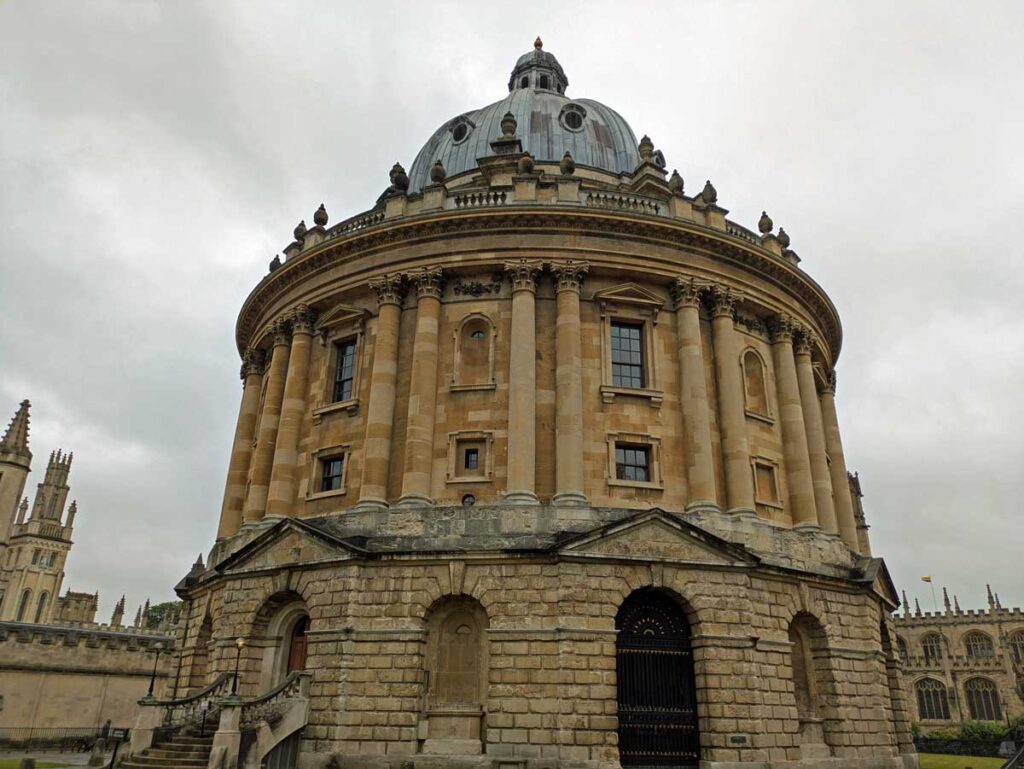
The Radcliffe Camera’s exterior is one of the most photographed views in Oxford and can be seen freely from the surrounding square at any time. Designed by James Gibbs and built between 1737 and 1749, the building is a masterpiece of English Baroque architecture — a round, domed structure in Portland stone rising on a two-storey base of rusticated arches. The drum of the building is ringed with paired Corinthian columns and topped by a lead dome.
The name “Camera” comes from the Latin for “room” — reflecting its original purpose as a standalone reading room. It was built using funds left by John Radcliffe, physician to William III and Queen Anne, to house a science library.
In 1861 the Radcliffe Library became the Radcliffe Camera and was incorporated into the Bodleian Libraries, renamed to distinguish it from a “library” in the modern sense.
Radcliffe Square itself is one of Oxford’s great public spaces, surrounded by All Souls College to the east, the University Church of St Mary the Virgin to the south, Brasenose College to the west, and the Old Bodleian to the north. The Square is accessible on foot freely at any time and provides the most commonly seen views of the building.
The interior
The interior consists of two circular reading rooms stacked vertically — a lower camera and an upper camera — connected by stairs. Both are fitted with dark wooden bookcases curving around the walls, reading tables, and ornamental ironwork balustrades. The rooms are lit by large windows and remain in active use as a library space for University of Oxford students and academics. The atmosphere is quiet and scholarly — the Bodleian asks that all visitors on tours maintain appropriate conduct in what remains a working library.
The interior can only be experienced on a guided tour and photography is not permitted inside at any time.
The Gladstone Link
The 90-minute library tour also includes the Gladstone Link, an underground tunnel connecting the Old Bodleian Library to the Radcliffe Camera, completed in 2011. The tunnel runs beneath Radcliffe Square and contains compact shelving with a significant part of the Bodleian’s collection. It provides an unusual contrast between the medieval and Baroque spaces above ground and the modern storage below.
Practical visitor tips
| Tip | Detail |
|---|---|
| Interior access is weekends only | The only public tours entering the Radcliffe Camera run on Saturdays and Sundays. There is no public access on any weekday via any tour. |
| Photography is not allowed inside | Unlike most of the Bodleian complex, photography of any kind is prohibited inside the Radcliffe Camera. Do not attempt to use a phone or camera inside. |
| Arrive early for the ticket desk | Walk-up tickets for Saturday and Sunday tours sell out quickly in summer. Arriving at the Weston Library when it opens (10am on Saturdays) gives the best chance. |
| The exterior is always free | Radcliffe Square is a public space. If you want to photograph or admire the building without joining a tour, simply walk into the square from the nearby streets — no charge, no booking. |
| The City Walking Tour is the fuller experience | The £30 Radcliffe Camera & City Walking Tour (Sat–Sun, 13:30) combines 30 minutes inside the building with an accredited guide-led walking tour of the city and entry to the Divinity School — a good value package for first-time Oxford visitors. |
Frequently asked questions about the Radcliffe Camera
| Question | Answer |
|---|---|
| Can you visit the Radcliffe Camera without a tour? | You can view the exterior freely from Radcliffe Square at any time. Interior access is by guided tour only — no independent access is available. |
| Is the Radcliffe Camera open during the week? | Not to the public. Public tours only run on Saturdays and Sundays. On weekdays it is accessible to registered Bodleian readers only. |
| Can you take photos inside the Radcliffe Camera? | No. Photography is not permitted inside the Radcliffe Camera under any circumstances. The exterior can be photographed freely from the square. |
| Which tour gives access to the Radcliffe Camera? | The 90-minute library guided tour (£22.50, Sat–Sun) and the Radcliffe Camera & City Walking Tour (£30, Sat–Sun at 13:30) are the only two public options. |
| Is the Radcliffe Camera suitable for children? | Children aged 11 and over may join the tours. Children 11–16 must be accompanied by a responsible adult. Younger children are not permitted on Bodleian guided tours. |
Things to do near the Radcliffe Camera
- Divinity School (same site, Old Bodleian) — The 15th-century Gothic examination hall, accessible via self-guided ticket or as part of the 30-minute, 60-minute, or 90-minute Bodleian guided tours. The Radcliffe Camera & City Walking Tour includes entry to the Divinity School after the tour.
- University Church of St Mary the Virgin (~1 minute, High Street) — Oxford’s main university church, with a tower climb offering views directly over the Radcliffe Camera and across the city skyline. Small admission charged for the tower. One of the best elevated views of the Radcliffe Camera available to the public.
- All Souls College (~1 minute, Radcliffe Square) — One of Oxford’s most architecturally distinctive colleges, surrounding Radcliffe Square on its eastern side. Open to visitors on weekday afternoons.
- Bodleian Old Schools Quadrangle (same site) — The 17th-century courtyard at the centre of the Old Bodleian complex is free to walk through when gates are open. The Tower of the Five Orders at the north side is among Oxford’s finest Renaissance architecture.
- Brasenose College (~1 minute, Radcliffe Square) — One of the colleges bordering Radcliffe Square, open to visitors at set times. Features the original brazen nose door knocker from which the college takes its name.
What to visit tomorrow: similar Baroque and classical buildings within two hours
- Blenheim Palace, Woodstock (~10 miles north) — A Baroque palace designed by John Vanbrugh, built 1705–1724. Broadly contemporary with the Radcliffe Camera and considered the finest English Baroque building. UNESCO World Heritage Site.
- St Paul’s Cathedral, London (~60 miles east) — Christopher Wren’s great Baroque dome, completed 1710, pre-dating the Radcliffe Camera and a direct influence on James Gibbs, its architect. Dome gallery offers elevated city views. Admission charged.
- St Philip’s Cathedral, Birmingham (~60 miles northwest) — Designed by Thomas Archer, 1715, a smaller-scale English Baroque church and a peer of Gibbs’s work.
- Christ Church, Spitalfields, London (~65 miles east) — Nicholas Hawksmoor’s 1729 church, a landmark of English Baroque at its most dramatic.
- Senate House, Cambridge (~80 miles northeast) — James Gibbs’s other great classical building in a university setting (completed 1730), predating the Radcliffe Camera and providing an interesting comparison of his work across both ancient universities.
More Oxfordshire travel
Other Oxfordshire travel articles on Planet Whitley include:
- 9 reasons to visit Oxford, England.
- Shudder at dark tales of incarceration at Oxford Castle and Prison.
- Oxford city centre attraction guides: The Museum of Oxford, the Story Museum and Carfax Tower.
- Enjoy the highlights of Oxford University, including the Ashmolean Museum, the Pitt Rivers Museum, the Museum of Natural History, the History of Science Museum and the Sheldonian Theatre.
- Are dogs allowed inside Blenheim Palace?