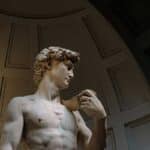
The Museo Nazionale del Bargello at Via del Proconsolo 4 in Florence is the world’s most important collection of Italian Renaissance sculpture — and one of the most undervisited major museums in the city. It houses two bronze Davids (Donatello and Verrocchio), Michelangelo’s Bacchus and Brutus, Cellini’s Bust of Cosimo I, and Bernini’s Bust of Costanza Bonarelli, among hundreds of other works.
The full price is €12, confirmed on the official Bargello Museums page — several aggregators still show the old price of €10. The ticket is valid for 48 hours, not 24 as most guides state. You can book through GetYourGuide in advance.
Quick facts
| Detail | Information |
|---|---|
| Address | Via del Proconsolo 4, 50122 Florence, Italy |
| Hours | Tuesday–Sunday, 08:15–18:50 |
| Closed | Mondays; 25 December; 1 January |
| Last admission | 50 minutes before closing (18:00) |
| Full ticket | €12 (valid 48 hours) |
| Combined with Accademia (48 hours) | €26 |
| 72-hour pass (all 5 Bargello Museums) | €38 |
| Reduced (EU citizens 18–25) | €2 |
| Under 18 | Free |
| Optional reservation fee | €4 |
| Free admission days | First Sunday of the month; 25 April; 4 November |
| Nearest bus stop | Multiple ATAF lines to Via del Proconsolo/Piazza San Firenze |
| Distance from Uffizi | 8-minute walk |
| Distance from Duomo | 5-minute walk |
| Typical visit | 1.5–2.5 hours |
Bargello Museum opening hours
The Bargello is open Tuesday to Sunday, 08:15 to 18:50. It is closed every Monday. It is also closed on 25 December and 1 January. The last admission is 50 minutes before closing — that is 18:00, not 18:20. Many guides state last admission as 30 minutes before closing; the official page specifies 50 minutes.
Free admission applies on the first Sunday of each month (#domenicamuseo), and on the national holidays of 25 April and 4 November.
Bargello Museum admission prices
The full ticket price is €12, confirmed on the official site (page last modified 25 March 2026). Several aggregators still show €10 (the pre-2025 price). The ticket is valid for 48 hours, not 24 — this is explicitly stated on the official tickets section and is useful for visitors who want to spread a visit across two days.
| Ticket | Price | Validity |
|---|---|---|
| Full ticket | €12 | 48 hours |
| Combined: Bargello + Accademia | €26 | 48 hours |
| 72-hour pass (all 5 Bargello Museums) | €38 | 72 hours |
| Reduced (EU citizens 18–25) | €2 | — |
| Under 18 | Free | — |
| Optional reservation fee | €4 | — |
The 72-hour pass covers the Bargello, Cappelle Medicee, Orsanmichele, Palazzo Davanzati, and Casa Martelli within 72 consecutive hours. Book through GetYourGuide for skip-the-line access.
Why visit the Bargello Museum?
- 🏛️ The world’s most important collection of Renaissance sculpture: Donatello’s two Davids, Michelangelo’s Bacchus, Verrocchio’s David, Cellini’s bronze Perseus model, and Bernini’s Bust of Costanza Bonarelli — all in one building that most Uffizi visitors miss entirely.
- 🎟️ Shorter queues than any comparable major museum in Florence: The Bargello is significantly less crowded than the Uffizi or Accademia, despite holding works of equivalent importance. Early morning or late afternoon visits are particularly quiet.
- 🌿 The medieval courtyard is one of the finest in Florence: The 13th-century Palazzo del Bargello, built in 1255 as Florence’s first public building, has a two-storey courtyard hung with the coats of arms of the Podestà magistrates. The loggia above holds Giambologna’s monumental bronze figures.
- 📜 Bernini’s Bust of Costanza Bonarelli (c.1637): The most psychologically intense portrait bust in the history of sculpture, depicting Bernini’s lover — virtually unknown outside specialist art history despite being one of the most remarkable objects in Italy.
- 💰 The ticket is valid for 48 hours: Unlike many Italian museums, the Bargello’s standard ticket allows return visits within 48 hours of first use — useful for visitors who want to return for a second pass through the collection.
How to get to the Bargello Museum
On foot from the Uffizi Gallery, the museum is an 8-minute walk north-east along Via della Ninna and Via del Proconsolo. From the Duomo, it is a 5-minute walk south on Via del Proconsolo. From Piazza della Signoria, it is a 3-minute walk east along the Borgo dei Greci.
By bus (ATAF), several routes pass along Via del Proconsolo or through Piazza San Firenze. Bus C2 connects the museum with the railway station; bus C1 connects with the Oltrarno.
By car, ZTL restrictions apply across the historic centre. Use car parks at Piazza della Stazione (SMN) or Fortezza da Basso and walk approximately 20 minutes.
5 great Florence experiences to book
- 🏛️ Cover Florence in a day – including the Duomo, Uffizi and skip-the-line tickets for Michelangelo’s David.
- 🍝 Learn how to make pasta the Tuscan way at a cooking class with unlimited wine.
- 🎨 On a guided tour of the Uffizi Gallery, discover the detail in the Renaissance masterpieces.
- 🗿 Discover much more than David on a guided tour of the Galleria dell’Accademia.
- 🍷 Take a 4WD Tuscan wine safari – with several winery tastings and a three-course lunch.
Parking at the Bargello Museum
There is no parking at the museum. ZTL restrictions apply across the historic centre. The nearest practical car parks outside the restricted zone are at Santa Maria Novella station (approximately 20 minutes’ walk) and Fortezza da Basso. Walking from any historic-centre accommodation takes under 10 minutes.
How long to spend at the Bargello Museum
Allow 1.5 to 2.5 hours. The museum covers three floors around the courtyard loggia — the Donatello/Verrocchio Hall (ground floor and upper loggia), the Michelangelo Hall, the Ivory and Maiolica rooms, the Della Robbia rooms, the Armoury, the Carrand Collection, and the Baroque Sculpture Room. Most visitors who focus on the sculpture spend around 90 minutes; those who explore the decorative arts collections need 2.5 hours. The 48-hour ticket allows splitting the visit over two days.
Accessibility at the Bargello Museum
The museum’s entrance pavement is at street level. Visitors can access all rooms except the Chapel and Sacristy, which have steps without ramp access. Elevation differences elsewhere are manageable via ramps with staff assistance, and a lift is available. Electric scooters and motorised wheelchairs are assessed case by case to ensure artwork safety.
Visually impaired visitors can request a touch visit to selected sculptures using gloves available at the ticket office; contact the museum’s Education Service in advance (Tel. 055 0649444, Tuesday–Wednesday 09:00–12:00; email mn-bar.didattica@cultura.gov.it). A tactile path diagram is available at the ticket office. An accessible restroom is on the second floor.
What to see at the Bargello Museum
The Donatello Hall and Upper Loggia hold the greatest concentration of 15th-century Florentine sculpture anywhere. Donatello’s bronze David (c.1440–1450) — the first large-scale freestanding nude since antiquity — stands at the centre, alongside his earlier marble David (c.1409) and the original Saint George from Orsanmichele. Verrocchio’s bronze David (c.1473–1476) and Giambologna’s bronze animals from the Medici gardens are on the upper loggia.
The Baptistery Doors Competition Panels by Brunelleschi and Ghiberti (both depicting The Sacrifice of Isaac, 1401) are displayed together in the Donatello Hall — the only place in the world where these two foundational works of the Renaissance can be compared side by side.
The Michelangelo Hall holds the largest group of Michelangelo sculptures outside Rome. The Bacchus (1496–1497) — made as a deliberately anti-heroic companion to ancient gods — is the most psychologically complex. The Apollo/David (1530, unfinished) and the Brutus (c.1540) are among the most debated works. Cellini’s Bust of Cosimo I (c.1545–1548) and his preparatory Perseus bronzes are on the same floor.
The Baroque Sculpture Room holds Bernini’s Bust of Costanza Bonarelli (c.1637). Depicting his lover Constanza, wife of his assistant Matteo Bonarelli, with an informality and psychological immediacy that breaks every convention of formal portraiture, it is one of the most extraordinary objects in Italian art — and one of the least discussed in travel writing.
The Carrand Collection and Ivory Room hold one of the finest accumulations of medieval decorative art in Italy — the 9th-century Flabellum of Tournus, Limoges enamels, Byzantine ivories, seals, and Islamic bronzes, donated by French collector Louis Carrand in 1888.
Practical tips for visiting the Bargello Museum
| Tip | Detail |
|---|---|
| The price is €12, not €10 | Several aggregators and one major fee-tracking site still show €10. The official 2026 price is €12. |
| Last admission is 18:00, not 18:20 or 18:30 | The official site specifies 50 minutes before the 18:50 closing. Arriving at 18:15 means no entry. |
| The ticket is valid for 48 hours | Unlike most Italian museums, the Bargello ticket allows a return visit within 48 hours — allowing the visit to be split across two sessions. |
| Seek out Bernini’s Costanza Bonarelli | This is one of the most remarkable objects in Italian art and is almost never mentioned in travel guides. It is in the Baroque Sculpture Room on the upper floor. |
| Book in advance | The optional reservation (€4) guarantees skip-the-line access. Queues are shorter than at the Uffizi but can form in peak summer at opening time. |
Bargello Museum FAQ
| Question | Answer |
|---|---|
| What is the full ticket price? | €12. Several aggregators still show €10 — that price predates 2025. The ticket is valid for 48 hours from first use. |
| What is the last admission time? | 18:00 — 50 minutes before the 18:50 closing. Not 18:20 or 18:30 as some guides state. |
| Is the museum accessible for wheelchairs? | Largely yes, with ramps and a lift, but the Chapel and Sacristy are not accessible. Electric scooters are assessed case by case. |
| Can I see Donatello’s David and Michelangelo’s David here? | Donatello’s David (bronze) is here. Michelangelo’s David is at the Accademia Gallery. A combined ticket (€26, 48 hours) covers both. |
| Is the museum closed on Mondays? | Yes, every Monday without exception. Also closed 25 December and 1 January. |
Things to do near the Bargello Museum
The Uffizi Gallery is an 8-minute walk west via Via della Ninna. The world’s greatest collection of Italian Renaissance painting shares the same neighbourhood and a combined Uffizi visit with the Bargello is one of the most rewarding single-day itineraries in Florence.
Piazza della Signoria is a 3-minute walk west. The civic square contains Michelangelo’s David (copy; original in the Accademia), Cellini’s Perseus and Medusa under the Loggia dei Lanzi, and Giambologna’s Rape of the Sabine Women — all free to view from the piazza.
The Badia Fiorentina is directly opposite the Bargello entrance and is one of Florence’s oldest churches. Open to visitors on Monday mornings only, it contains Filippino Lippi’s Apparition of the Virgin to St Bernard (1486).
Palazzo Vecchio is 5 minutes west on Piazza della Signoria — the medieval and Renaissance town hall, containing Vasari’s battle frescoes, Donatello’s Judith and Holofernes, and the Sala dei Gigli. Museum admission separate; courtyard free.
Santa Croce is 10 minutes’ walk south-east and is the principal Franciscan church of Florence. The nave holds the tombs of Michelangelo, Machiavelli, Galileo, and Ghiberti alongside Donatello’s gilded bronze Annunciation and Cimabue’s Crucifix (restored after the 1966 flood). Admission charged.
Similar sculpture museums to visit near Florence
The Galleria dell’Accademia, Florence houses Michelangelo’s David (1504) in a purpose-built tribune and his four unfinished Prisoners. Combined ticket with the Bargello (€26, 48 hours) is strongly recommended. Around 15 minutes’ walk north-west.
Orsanmichele, Florence is included in the 72-hour Bargello pass. The former grain market, converted into a church in the 14th century, has the original sculptures from its external niches (including the original Donatello Saint George whose copy remains outside) now displayed inside. Around 10 minutes’ walk west of the Bargello.
The Museo dell’Opera del Duomo, Florence holds Michelangelo’s late Pietà, Donatello’s extraordinary Penitent Magdalene and his two cantorie (singing galleries), and the original gilded bronze Baptistery panels by Ghiberti. 10 minutes’ walk north. Essential for understanding Donatello and Ghiberti.
Palazzo Davanzati, Florence is a 14th-century merchant’s house preserved almost entirely intact, included in the 72-hour Bargello pass. Around 15 minutes’ walk west. Domestic life rather than sculpture, but one of the finest intact medieval interiors in Italy.
The Medici Chapels, Florence are also included in the 72-hour pass and contain Michelangelo’s Night, Day, Dawn, and Twilight in the Sagrestia Nuova. Around 20 minutes’ walk north-west from the Bargello.
More Tuscany travel
Other Tuscany travel guides on Planet Whitley include:
- Why do hot air balloon flights in Tuscany leave so early?
- How to visit two Chianti Classico wineries from Florence in one afternoon.
- Learning to make pasta in Florence.
- How long are the queues to see Michelangelo’s David?
- Florence attraction guides: Palazzo Vecchio, Medici Chapels, Museo de Medici, Uffizi Gallery, Museo Galileo, Florence Synagogue and Museum, Pitti Palace and Boboli Gardens.