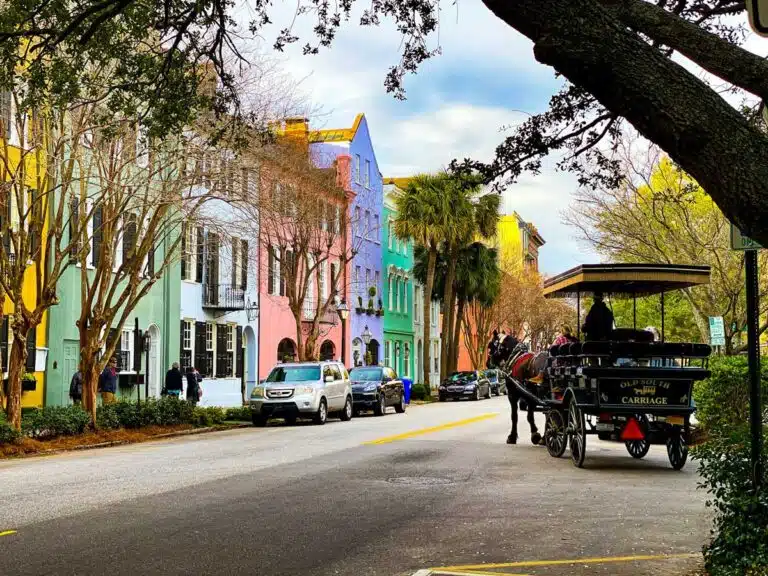
Charleston is one of the most historically layered cities in the American South — a colonial port that grew wealthy on the labour of enslaved people, whose antebellum architecture survives largely intact along the Battery and the streets of the South of Broad neighbourhood, and where the first shots of the American Civil War were fired on a fortified island in the harbour. The city’s historic house museums — including two of the finest antebellum interiors accessible to the public in the country — sit alongside a ring of plantation estates that now address their histories with varying degrees of honesty. Dolphins are a near-daily presence in the Charleston Harbor and the tidal creeks of the Lowcountry, and the Cypress Gardens swamp north of the city is one of the most atmospheric natural landscapes in the Southeast. These guides cover Charleston’s key attractions with practical information on ticket prices, opening hours, parking and what to expect on arrival.

Charleston’s historic sites and museums
Charleston’s compact historic district contains a concentration of significant buildings and museums that rewards days of slow exploration. The two house museums listed here are among the finest preserved antebellum interiors in the country — and between them tell very different stories about who lived in 19th-century Charleston and under what conditions.
- Nathaniel Russell House Museum, Charleston: ticket prices, hours and visitor tips — a magnificent Federal-style mansion built in 1808 for one of Charleston’s wealthiest merchants, with a famous freestanding spiral staircase, original furnishings and an exhibition that addresses the enslaved people who built and maintained the house alongside the Russell family.
- Aiken-Rhett House Museum, Charleston: parking, prices, hours and visitor tips — a Greek Revival townhouse preserved in a state of deliberate arrested decay by Historic Charleston Foundation, with original wallpapers, furnishings and — unusually — the surviving slave quarters in the rear courtyard, making it one of the most important and honest sites for understanding urban slavery in the antebellum South.
- Fort Sumter ferry, Charleston: times, fares and how to book — the National Park Service ferry to the island fort in Charleston Harbor where Confederate forces fired the opening shots of the American Civil War in April 1861, with a 30-minute crossing, a ranger-led site visit and views back across the harbor toward the Charleston skyline.
- Gibbes Museum of Art, Charleston: parking, prices, hours and visitor tips — the primary art museum of the South Carolina Lowcountry, with a permanent collection focused on American art with Charleston and Southern connections, a significant collection of portrait miniatures and a programme of temporary exhibitions that makes it worth revisiting on return trips.
The plantation circuit: estates around Charleston
The plantation estates surrounding Charleston are among the most significant and most visited historic sites in the American South — and the most complex to interpret. All four covered here were built and maintained by enslaved labour, and each now addresses that history to different degrees and with different approaches. Drayton Hall is the most historically rigorous; Magnolia and Middleton Place balance history with horticultural appeal; Boone Hall is the most commercially oriented. Understanding these differences before visiting helps set appropriate expectations.
- Drayton Hall, Charleston: ticket prices, hours and visitor tips — the only surviving plantation house on the Ashley River to have escaped destruction during the Civil War, maintained without modernisation since the 1970s, with guided tours that place the experiences of the enslaved people at the centre of the narrative in a way that distinguishes Drayton Hall from most comparable sites.
- Magnolia Plantation and Gardens, Charleston: ticket prices, hours and visitor tips — one of the oldest public gardens in America, with 70 acres of informal gardens, azaleas and camellias at their most spectacular in late March, alongside wildlife-rich swamp boardwalks, a petting zoo and a slavery-focused cabin tour that has become one of the most developed on the Ashley River plantation road.
- Middleton Place, Charleston: ticket prices, hours and visitor tips — home to the oldest landscaped gardens in America, begun in 1741, with terraced lawns, reflecting pools and the Butterfly Lakes still intact, alongside a working Stableyards with heritage livestock and a house museum covering both the Middleton family history and the lives of the enslaved people on the property.
- Boone Hall Plantation, Mount Pleasant: ticket prices, hours and visitor tips — the most recognisable of the Charleston-area plantations thanks to its famous Avenue of Oaks, used as a filming location for several productions including The Notebook, with a functioning farm, seasonal strawberry and peach picking and a Gullah Geechee cultural experience alongside the historic house and slave cabin exhibition.
Nature, wildlife and outdoor Charleston
The South Carolina Lowcountry — the tidal creeks, marshes and blackwater swamps surrounding Charleston — is one of the most ecologically rich coastal landscapes in the American East. Bottlenose dolphins are almost permanently present in the harbour and waterways, and the Cypress Gardens swamp north of the city is among the most atmospheric natural landscapes in the Southeast.
- Cypress Gardens, South Carolina: ticket prices, hours and visitor tips — a former rice plantation reservoir north of Charleston, now a blackwater swamp garden of extraordinary atmosphere, where ancient bald cypress trees draped in Spanish moss rise from still dark water, navigable by flat-bottomed boat, and used as a filming location for The Notebook.
- The best places to see dolphins in South Carolina: a complete guide — a guide to the most reliable locations across the South Carolina Lowcountry for encountering wild bottlenose dolphins, covering the Charleston Harbor, the Isle of Palms waterways and the best operators offering dolphin watching boat tours from the Charleston area.
Planning your Charleston visit
Charleston’s historic district is compact and walkable — the main house museums, the waterfront and the French Quarter gallery district are all within easy walking distance of each other. Spring (March to May) is the most visited season, when the azaleas at Magnolia Plantation and the Charleston gardens are in peak bloom and the Spoleto Festival USA in May fills the city. Autumn (September to November) offers warm temperatures and smaller crowds; summer is very hot and humid but generally manageable with air-conditioned museums and early morning outdoor activity. The plantation estates are all located on the Ashley River road west of the city and require a car or organised tour to reach; they can be combined into a single day but are better spread across two. The Fort Sumter ferry books out in peak season — advance booking is strongly recommended.
How many days do you need in Charleston?
Three days covers Charleston comfortably. A first day suits the historic district — the Nathaniel Russell House, a walk through South of Broad and the Battery, the Gibbes Museum and an evening on King Street. A second day works well for Fort Sumter in the morning and the Aiken-Rhett House in the afternoon. A third day suits the plantation circuit — Drayton Hall and Magnolia Plantation can be combined in a single day, or Middleton Place for those who want more garden content. A fourth day allows Cypress Gardens and a dolphin watching tour.
What is Charleston best known for?
Charleston is best known for its antebellum architecture, its plantation history, its food scene — widely considered one of the finest in the American South — and its role in the American Civil War as the site of the first shots at Fort Sumter. The city’s Gullah Geechee culture, descended from the West African enslaved people brought to the Lowcountry, is increasingly prominent in how Charleston presents its history, and the best plantation and historic site tours now place that heritage at the centre rather than the margins of the narrative.