Dettifoss is a glacial waterfall in the Jökulsárgljúfur canyon within Vatnajökull National Park in north-east Iceland. It is widely regarded as the most powerful waterfall in Europe. This guide covers road access and seasonal conditions, admission, parking, transport, accessibility, and practical tips for planning a visit.
Updated May 2026. Management of Vatnajökull National Park transferred to the Nature Conservation Agency of Iceland (Náttúruverndarstofa) in early 2025; the agency’s own website is still being developed, and official visitor information continues to be hosted at vatnajokulsthjodgardur.is. Road 864 (east side) is typically closed until late May or early June each year. Always verify current road status before setting out.
Quick facts
| Detail | Information |
|---|---|
| Access | Open at all times (subject to road conditions and weather) |
| Road 862 (west side) | Paved; open approximately April–December; limited winter service |
| Road 864 (east side) | Gravel; closed when snow falls in autumn; reopens late May or June |
| Admission | Free |
| Parking | Free; toilets on both sides |
| Overnight stays | Not permitted at the Dettifoss car park |
| Location | Jökulsárgljúfur, Vatnajökull National Park, north-east Iceland |
| Coordinates | 65.8117° N, 16.3843° W |
| Distance from Akureyri | ~135 km; approximately 2 hours by car |
| Distance from Mývatn (Reykjahlíð) | ~45 km; approximately 40–45 minutes by car |
| Typical time needed | 1–2 hours for the falls and Selfoss; 3–4 hours including Hafragilsfoss |
Dettifoss access and seasonal conditions
Dettifoss is a natural site with no staffed entry point or ticketed opening hours. The waterfall is accessible at all times of day when roads are passable. Road conditions are the primary planning factor, and they differ significantly between the two approach roads.
Road 862 (west side) is a fully paved road running from the Ring Road (Route 1) to the west bank of Dettifoss and continuing north towards Ásbyrgi. It is generally open from April to December, with some winter service beyond that. However, the official park guidance notes that Road 862 has limited winter service and can close at short notice in poor weather. In winter and shoulder seasons, check conditions before travelling.
Road 864 (east side) is an unpaved gravel road with no winter service. It closes when snow arrives in autumn — typically October — and reopens in late May or June, depending on how quickly snow and mud dry after the winter. The exact opening date varies each year and is not fixed in advance. Road 864 is driveable in a standard car when conditions are good, but the surface is rough and slow; a 4WD vehicle provides more confidence. Check the park’s alerts page for current status before choosing this route.
Five great things to do in Husavik
- 🐋 Go whale-watching – the traditional way on a handsome oak ship.
- 🚤 Get a taste of adventure on a RIB cruise – spotting whales and puffins on the way.
- ♨️ Soak in the mineral-rich waters – at the GeoSea Geothermal Baths.
- 🌊 Head out again in search of whales in Skjalfandi Bay – on another guided boat tour.
- 📸 Capture the coastline’s beauty – while exploring more Husavik highlights on a local experience.
Admission to Dettifoss
Entry to Dettifoss and the Jökulsárgljúfur area is free. There is no admission charge for the waterfall, the car parks, or the marked hiking trails. Parking is also free on both the east and west sides. No regional parking fee of the type charged at Skaftafell or Jökulsárlón applies to the Dettifoss car parks; these areas are not fee zones.
There is no city or national pass that applies at Dettifoss, as no ticket is required. Camping fees apply only at the designated Ásbyrgi campsite (ISK 2,800 per person per night) and the Vesturdalur tent-only site; the Dettifoss car park itself is not a campsite and overnight parking is not permitted.
Admission details were checked on the official park website and pricelist and last updated in May 2026.
How to get to Dettifoss
Dettifoss is reached by private car only. There is no public bus service to the waterfall; the nearest the public bus network comes is a stop on the Ring Road, approximately 25 km from the west-side car park via Road 862. If you do not have a car, the practical options are a guided tour from Akureyri or Mývatn, or a private transfer.
From the Ring Road (Route 1): Turn onto Road 862 for the west side, or Road 864 for the east side. Both junctions are signposted from the Ring Road. The drive on Road 862 to the car park takes approximately 25 minutes from the junction; Road 864 is slower due to the road surface.
From Akureyri: Approximately 135 km and 2 hours via the Ring Road to the Road 862 junction. Akureyri has the nearest international airport (AEY) with connections to Reykjavík; car hire is available at the airport.
From Mývatn (Reykjahlíð): Approximately 45 km and 40–45 minutes, making Mývatn the most practical base for a Dettifoss day visit.
From Reykjavík: Approximately 450 km and 5–6 hours by car. Most visitors based in Reykjavík approach Dettifoss as part of a multi-day Ring Road trip, with an overnight stop in the Mývatn or Akureyri area.
Always check road.is and the Icelandic Met Office (en.vedur.is) for conditions before travelling, particularly outside June–August.
Parking at Dettifoss
Free car parks are provided on both the west side (Road 862) and the east side (Road 864). The west-side car park is larger and more developed, with marked walking paths and toilets. The east-side car park is smaller; toilets are available. Overnight parking is not permitted at either car park. The nearest authorised camping is at Ásbyrgi (approximately 30 km north via Road 862) and Vesturdalur (accessible via the canyon trail).
How long to spend at Dettifoss
Allow 1 to 2 hours to walk to Dettifoss, view the waterfall, and return to the car park via the marked trail. The walk from either car park to the main viewpoint takes 10–20 minutes, depending on the approach. Extending the visit to include Selfoss (an additional 2.5 km circuit, approximately 1 hour) is straightforward and adds significantly to the visit. Including Hafragilsfoss downstream requires a further hike of around 3 km each way from Dettifoss; the full Hafragilsfoss route (trail D3) is rated difficult and takes approximately 4 hours in total, with a risk of falling rocks.
Accessibility at Dettifoss
The paths to Dettifoss are uneven, rocky, and often wet. Neither side has a wheelchair-accessible route to the main viewpoint. The east side (Road 864) involves a shorter walk to the canyon edge but across rougher terrain. The west side (Road 862) has a longer, better-marked path with viewing platforms, though it is not suitable for wheelchairs or those with significant mobility limitations. Spray from the waterfall makes the ground near the edge consistently wet and slippery; appropriate footwear is essential year-round. Paths can be icy in winter and shoulder seasons.
What to see at Dettifoss
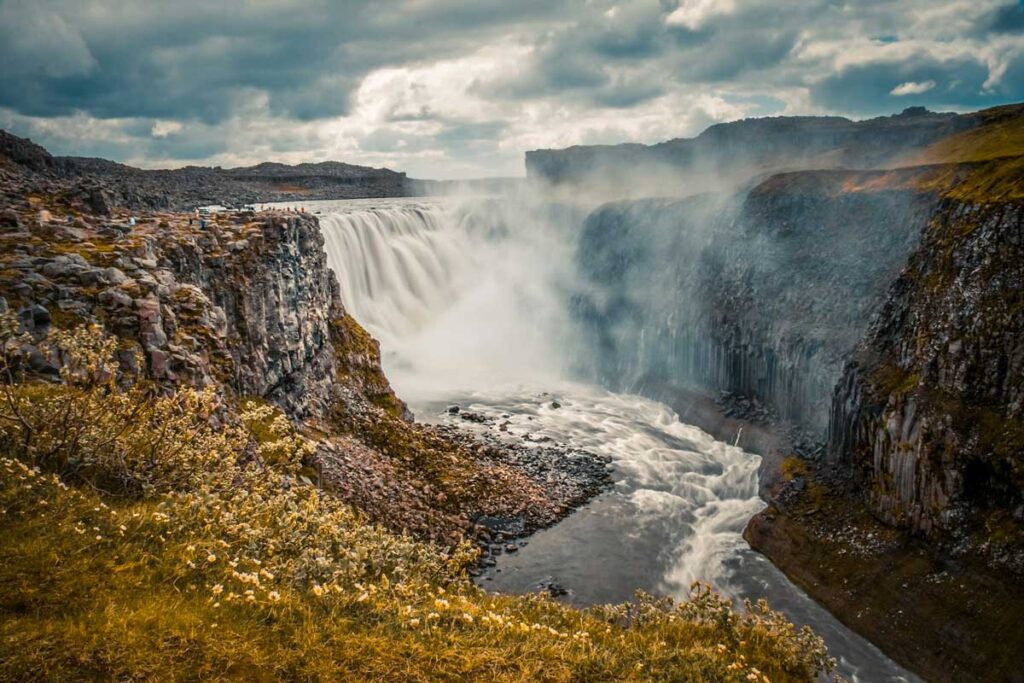
Dettifoss itself drops 44–45 metres over a width of approximately 100 metres. It is fed by the glacial river Jökulsá á Fjöllum, which originates in the Vatnajökull ice cap. At peak summer flow, the discharge averages around 193 cubic metres per second, rising significantly during glacial melt. The force of the water causes the canyon walls and rocks near the edge to vibrate; this can be felt by placing a hand on the rock surface. The mist from the falls is substantial and will dampen clothing within a few minutes of standing at the viewpoint.
Selfoss, located approximately 1 km upstream, is a wide, shallow waterfall with a drop of around 10 metres. Its character is entirely different from Dettifoss — broader and quieter — making the two a practical pairing on the same visit. Trail D2 (2.5 km, 1 hour, easy) covers both waterfalls in a single circuit from the car park.
Hafragilsfoss, approximately 2 km downstream from Dettifoss, has a drop of 27 metres and sits in a narrower section of the canyon. On the east bank near Hafragilsfoss, a cross-section of the volcanic fissure Randarhólar exposes the feeder dike in the canyon wall, a formation of geological interest. The hike to Hafragilsfoss is rated difficult and involves steep sections and a risk of falling rocks.
The Jökulsárgljúfur canyon is the wider geological setting, carved by the river and by outburst floods over millennia. The narrowest point of the canyon — approximately 100 metres wide — lies immediately north of Dettifoss and was shaped by the waterfall’s daily erosion, which moves the lip of the falls southward by roughly half a metre per year.
Practical visitor tips
| Tip | Detail |
|---|---|
| Check roads before setting out | Road 864 (east) is closed for much of the year and can be impassable even when technically open. Road 862 (west) can also close at short notice in winter. Always verify conditions the day before and the morning of your visit. |
| Bring waterproof clothing | The mist from Dettifoss is heavy and unavoidable at the main viewpoints. Even on dry days, visitors without waterproof outer layers will get wet. This applies to cameras and bags as well. |
| Wear appropriate footwear | The paths are rocky, uneven, and consistently wet near the falls. Waterproof walking boots with grip are strongly recommended; trainers or sandals are inadequate and potentially hazardous. |
| Visit early in the day | The west side (Road 862) receives the majority of visitors and is busiest between mid-morning and early afternoon in summer. Arriving before 9:00am or after 5:00pm significantly reduces crowding. |
| No facilities beyond toilets | There are no food or drink outlets, no accommodation, and no phone signal at Dettifoss. Carry water and snacks, and ensure your car has fuel before leaving the Mývatn area. The nearest services are approximately 45 minutes away. |
Frequently asked questions about Dettifoss
| Question | Answer |
|---|---|
| Is Dettifoss free to visit? | Yes. There is no admission charge and no parking fee. The car parks on both sides are free. |
| Do you need a 4WD to visit Dettifoss? | Not for the west side (Road 862), which is fully paved and suitable for all cars. Road 864 (east side) is a rough gravel road; a 4WD is strongly recommended if you take that route. |
| Is Dettifoss open in winter? | The waterfall itself has no opening hours, but road access is severely restricted in winter. Road 864 is completely closed. Road 862 has limited winter service and can close at short notice. Winter visits require careful preparation and real-time road checks. |
| Which side of Dettifoss is better — east or west? | The west side (Road 862) is better for most visitors: paved access, a longer season, more facilities, and marked paths with viewing platforms. The east side gives a more immediate, closer view of the falls and is quieter, but requires a 4WD, a rougher drive, and a more limited seasonal window. |
| Can you visit Dettifoss without a car? | Practical access requires a car. There is no public bus service. Guided tours from Akureyri or Mývatn are available and include transport; these are the main alternative to self-driving. |
Things to do near Dettifoss
- Selfoss waterfall – A broad, low waterfall approximately 1 km upstream from Dettifoss on the same river; reached on foot via trail D2 from the Dettifoss car park. It can be combined with Dettifoss in a single 1-hour circuit.
- Hafragilsfoss – A 27-metre waterfall downstream in the Jökulsárgljúfur canyon, accessible by the difficult trail D3 from Dettifoss (rated difficult, 9 km, approximately 4 hours); also viewable from the Road 864 side by driving a short distance past the Dettifoss car park.
- Ásbyrgi canyon – A horseshoe-shaped glacial canyon approximately 30 km north via Road 862, with a visitor centre (Gljúfrastofa), marked walking trails, and a campsite. The canyon’s scale and distinctive shape make it a practical half-day addition to a Dettifoss visit.
- Hljóðaklettar (echo cliffs) – A basalt column formation in the Jökulsárgljúfur area between Dettifoss and Ásbyrgi, with walking trails through unusual volcanic rock formations; approximately 20–25 km from Dettifoss via Road 862.
- Lake Mývatn – A shallow geothermal lake approximately 45 km south of Dettifoss, surrounded by lava formations, pseudo-craters, hot springs, and mud pools; the Mývatn area is the most practical base for visiting Dettifoss and contains accommodation, restaurants, and fuel.
What to visit tomorrow: other major Icelandic waterfalls within two hours
- Goðafoss – A wide, dramatic waterfall on the Skjálfandafljót River along the Ring Road, approximately 75 km and 1 hour south-west of Dettifoss; named the “Waterfall of the Gods” and one of the most visited waterfalls in Iceland, with easy roadside access and free admission.
- Aldeyjarfoss – A striking basalt-framed waterfall on the Skjálfandafljót River in the highlands, approximately 90–120 km from Dettifoss depending on the route; partly accessed via F-road 842, which requires a 4WD and is closed in winter.
- Selfoss and Hafragilsfoss – Immediately adjacent to Dettifoss in the same canyon; both are practical same-day additions rather than separate destinations.
- Rjúkandi waterfall – A series of waterfalls in the East Iceland highlands, accessible from the Ring Road near Egilsstaðir, approximately 2 hours from Dettifoss via the eastern Ring Road; a quieter, less-visited alternative for those continuing the Ring Road circuit.
- Dettifoss from the east side (Road 864) – If you visit via Road 862 on your first day, the east side of Dettifoss offers a distinct, closer vantage point worth treating as a separate visit when Road 864 conditions allow. The two sides of the same waterfall provide genuinely different perspectives.
More Iceland travel
Other Iceland travel guides on Planet Whitley include:
Húsavík Whale Museum: ticket prices, hours and visitor tips — a devoted museum in Iceland’s whale-watching capital.
GeoSea geothermal sea baths, Húsavík: ticket prices, hours and visitor guide — infinity pools of geothermally heated seawater on the cliffs above Húsavík harbour.
Forest Lagoon, Akureyri: ticket prices, opening hours and practical visitor guide — a geothermal lagoon set in birch forest above Iceland’s second city.
Museum of Icelandic Sorcery and Witchcraft, Hólmavík: ticket prices, hours and visitor guide — a genuinely strange and compelling small museum in a remote Westfjords fishing village.
Skógafoss waterfall, Iceland: opening hours, parking and visitor guide — a 60-metre curtain of water at the foot of a former sea cliff, with a staircase to the top offering views along the coast.