
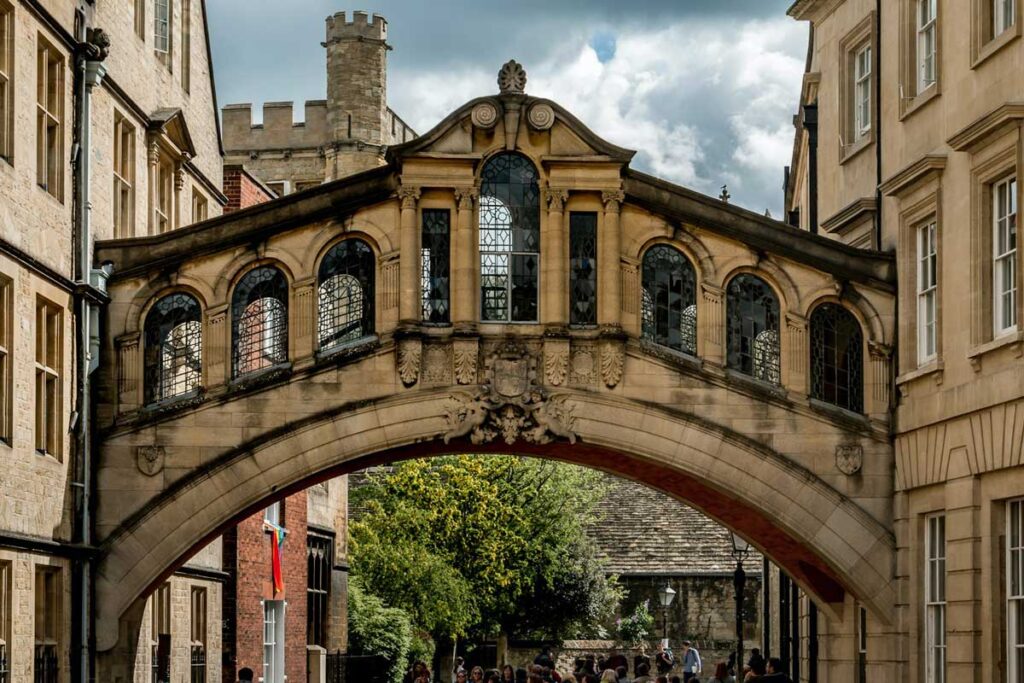
The Bridge of Sighs — officially Hertford Bridge — is a covered stone footbridge spanning New College Lane in central Oxford, connecting the old and new quadrangles of Hertford College. Designed by Sir Thomas Graham Jackson and completed in 1914, it is one of the most photographed structures in Oxford. The bridge is private college property: the exterior and the lane below are freely accessible at all times, but crossing the bridge is restricted to Hertford College members. This guide covers how to find it, where to photograph it, and what to see.
My personal Oxford recommendation
Oxford is a city of stories. You miss a lot of the walking around independently. This is a place where, much more than usual, it’s worth taking a walking tour.
I took the excellent Official Oxford University and City walking tour. It gave a great grounding on the city’s history, quirky university traditions and fascinating details on buildings you may otherwise miss. I recommend it, but there are other Oxford walking tours to choose from if you’d prefer a different theme.
Last updated: June 2026. Two important corrections to widespread misconceptions: the bridge is not architecturally modelled on the Bridge of Sighs in Venice — it more closely resembles the Rialto Bridge in the same city. And the bridge is not walkable by visitors — a fact that several tourist-facing descriptions obscure by describing it as somewhere to “walk across.” You cannot.
Quick facts
| Detail | Information |
|---|---|
| Official name | Hertford Bridge |
| Location | New College Lane, Oxford — between Catte Street and the Queen’s Lane junction |
| Opening hours | New College Lane is a public right of way, accessible at all times |
| Entry price | Free (exterior and lane below only) |
| Bridge interior | Not open to the public — Hertford College members only |
| Managed by | Hertford College, University of Oxford |
| Nearest landmark | Bodleian Old Bodleian Library (immediately adjacent); Sheldonian Theatre (~1 min) |
| Typical visit length | 10–15 minutes |
Bridge of Sighs opening hours
New College Lane is a public right of way accessible at all times of day and night. The bridge can be viewed and photographed from the lane below 24 hours a day, year-round.
The bridge itself is not open to the public at any time. It is an enclosed walkway connecting two parts of Hertford College and is used exclusively by college students, fellows, and staff.
5 Oxford experiences worth booking
- 🎓 Take an Oxford University walking tour led by an alumni guide.
- ⚡ Explore Oxford’s Harry Potter filming locations on a tour including New College.
- 🚣 Embark on a scenic river cruise along the University Regatta course.
- 🕵️ Discover the Oxford of Morse, Lewis and Endeavour on a themed walking tour.
- 🏰 Hear dark historic tales on a guided visit to Oxford Castle and Prison.
Bridge of Sighs ticket prices
Viewing the bridge from New College Lane is free. No ticket, booking, or admission is required.
The bridge is not included in any commercial city pass scheme.
How to find the Bridge of Sighs
New College Lane is a narrow pedestrian lane running between Catte Street (the street that runs past the Bodleian Library‘s Great Gate) and Queen’s Lane (which continues east past the rear of the Bodleian and along the side of New College).
From Catte Street: With your back to the Tower of the Five Orders (the Bodleian gatehouse), turn right (north). After a few metres, New College Lane opens on your right. Walk east along the lane; the bridge is approximately 50 metres in.
From Broad Street: Walk east past the Sheldonian Theatre and the Museum of the History of Science. Turn right onto Catte Street, then immediately right again into New College Lane.
From Radcliffe Square: Exit the square via the passage north of the Radcliffe Camera onto Catte Street, then take New College Lane on the right.
The lane is narrow, cobbled, and easily missed. It runs between tall college walls and is shaded for much of the day. Look for a signpost or simply follow Catte Street northward from the Old Bodleian gatehouse.
How to get to the Bridge of Sighs
The bridge is in the heart of the Bodleian Library area of central Oxford, within 2 minutes’ walk of the Sheldonian Theatre, the History of Science Museum, and Radcliffe Square.
By bus: Multiple routes and Park & Ride services stop at Carfax or St Giles’. Walk east from Carfax along High Street, then north on Catte Street.
By train: Oxford station is approximately 15 minutes’ walk. Head east through the city centre.
On foot: If you can find the Bodleian Library, the bridge is 1 minute’s walk away. Take New College Lane from Catte Street.
Parking
No visitor parking is available near the bridge. The surrounding streets are pedestrianised or heavily restricted. Use the Park & Ride network or city-centre car parks at Gloucester Green, Westgate, or Oxpens Road.
How long to spend at the Bridge of Sighs
Allow 10 to 15 minutes at the bridge. Most visitors view it from a few positions along New College Lane, take photographs, and move on. The lane is short and the bridge is the only reason to walk along it. It combines naturally with the adjacent Bodleian Library complex and Broad Street into a 30–45 minute walking circuit.
Accessibility
New College Lane is a public lane with a cobbled surface, which can be uneven. There are no steps. The lane is narrow, with limited space for wheelchairs or mobility aids to pass, particularly when crowded. The bridge itself is not accessible to the public in any form.
What to see at the Bridge of Sighs
The bridge itself
Hertford Bridge was designed by Sir Thomas Graham Jackson (1835–1924), who was responsible for much of the late Victorian and Edwardian rebuilding of Hertford College, including the chapel, the New Hall, and the New Quadrangle. The bridge was built in 1914 to provide a covered connection between the college’s Old Quadrangle (to the west of New College Lane) and the New Buildings (to the east), sparing students the need to cross the lane in all weathers.
The bridge is a two-storey structure. The lower level consists of open arches with decorative stonework. The upper level — the enclosed walkway — has tall Gothic windows on each side, with carved stone tracery. At the centre of the upper level, facing the lane, is a carved coat of arms. The overall composition is symmetrical and ornate.
The Venice comparison: Rialto, not Bridge of Sighs
The bridge has been called the “Oxford Bridge of Sighs” for over a century, by analogy with the famous covered bridge in Venice. However, the architectural resemblance is to the Rialto Bridge, not the Bridge of Sighs. The Venetian Bridge of Sighs (Ponte dei Sospiri, 1600) is a low, enclosed Baroque passage connecting the Doge’s Palace to the prison; it is plain-walled and functional. Hertford Bridge’s arched, window-filled design matches the open multi-arch profile of the Rialto Bridge far more closely. The nickname stuck regardless, and most sources use it without caveat.
The best viewing position
The bridge spans New College Lane at a slight curve, meaning there is no single straight-on viewpoint. The most commonly used viewing positions are:
From the west end of New College Lane (Catte Street end): Looking east along the lane, the bridge is framed by the narrow lane walls with the upper floors of Hertford College visible beyond it. This is the most common photograph.
From directly below: Standing in the lane under the bridge gives a clear view of the lower arches and the carved stonework on the underside and sides.
From the eastern end of the bridge (Queen’s Lane side): A less common angle, looking back west, showing the bridge against the Bodleian Library walls behind it.
From the Sheldonian Theatre cupola: The Sheldonian’s upper gallery (admission charged; check open dates) provides an elevated view across the Oxford roofscape that includes Hertford Bridge. This is the only publicly accessible elevated vantage point from which the bridge’s roof can be seen.
Hertford College
The bridge is part of Hertford College, which was refounded in its current form in 1874 (though its predecessor institutions date to the 13th century). The college’s Old Quadrangle, visible through the arch to the west of the bridge, is one of the few parts of central Oxford that contains genuinely medieval domestic-scale architecture. The college is sometimes open to visitors during specific hours, particularly in the afternoons — check the Hertford College website before visiting if you want to explore the quadrangle.
Practical visitor tips
| Tip | Detail |
|---|---|
| You cannot walk across the bridge | The bridge is private Hertford College property. There is no public access. A number of tour descriptions use language that implies you can “cross” it — you cannot. |
| The best light is in the morning | New College Lane runs roughly east-west and is in shadow for much of the afternoon. Morning visits produce better light for photography, particularly in summer. |
| The lane can be crowded at midday | The lane is narrow, and a popular tourist stop. Mid-morning and late afternoon visits are quieter than the midday rush, which can make both photography and simply standing still to look more difficult. |
| It is not modelled on the Venetian Bridge of Sighs | The nickname is an analogy, not an architectural description. The Oxford bridge is more similar in appearance to Venice’s Rialto Bridge. |
| Combine with the Bodleian complex | New College Lane exits onto Catte Street immediately beside the Bodleian Library’s Great Gate and the Tower of the Five Orders. The entire Broad Street architectural ensemble is within 2 minutes of the bridge. |
Frequently asked questions about the Bridge of Sighs Oxford
| Question | Answer |
|---|---|
| Can you walk across the Bridge of Sighs in Oxford? | No. The bridge is a private Hertford College walkway. Members of the public cannot cross it at any time. It can be viewed freely from the lane below. |
| Is the Bridge of Sighs free to see? | Yes. New College Lane is a public right of way. There is no charge to walk along it and view the bridge. |
| Is the Oxford Bridge of Sighs based on the Venice one? | The nickname is a loose comparison. Architecturally it resembles the Venice Rialto Bridge more than the Bridge of Sighs. |
| What is the bridge officially called? | Hertford Bridge. It connects the two quadrangles of Hertford College over New College Lane. |
| When was the Oxford Bridge of Sighs built? | It was completed in 1914, designed by Sir Thomas Graham Jackson. |
Things to do near the Bridge of Sighs
- Tower of the Five Orders (~1 minute west, Catte Street/Old Bodleian) — The five-storey Jacobean gatehouse of the Old Schools Quadrangle, freely viewable from Catte Street. Walk through the Great Gate into the quadrangle for free.
- Sheldonian Theatre (~2 minutes west, Broad Street) — Wren’s 1669 ceremonial hall, open on most days for a paid visit. The cupola offers an elevated view across the roofscape that includes the Bridge of Sighs.
- History of Science Museum (~2 minutes west, Broad Street) — The world’s oldest surviving purpose-built museum building.
- Hertford College (~immediately adjacent) — The college the bridge belongs to is sometimes open to afternoon visitors. Check the college website for current opening times.
- New College Lane itself — The lane continues east past the bridge to the rear of the Bodleian Library and along the wall of New College. It is one of the most atmospheric pedestrian lanes in central Oxford and worth walking in its entirety.
What to visit tomorrow: similar ornamental college bridges and Gothic Revival architecture within two hours
- Bridge of Sighs, Cambridge (~80 miles northeast) — St John’s College Cambridge has its own Bridge of Sighs (1831), a fully enclosed Neo-Gothic covered bridge over the River Cam. Unlike Oxford’s, it is a genuine attempt to evoke the Venetian original. Viewable freely from the riverbank; punting tours pass underneath.
- Mathematical Bridge, Cambridge (~80 miles northeast) — Queen’s College’s timber footbridge (1749 original design, current structure 1905), a landmark of Cambridge engineering history. Viewable from the riverside for free.
- Magdalen Bridge, Oxford (~10 minutes’ walk east) — The historic road bridge over the River Cherwell at the eastern end of High Street, with the Magdalen College tower directly above it. Free to walk across; the tower is on the Addison’s Walk route inside the college (admission charged).
- Blenheim Palace Bridge, Woodstock (~10 miles north) — Vanbrugh’s dramatic Grand Bridge at Blenheim, spanning a lake created by Capability Brown. Viewable from the palace grounds; admission charged.
- Folly Bridge, Oxford (~10 minutes’ walk south) — The historic bridge at the southern end of St Aldate’s, marking the point where Oxford’s name (from “Oxen Ford”) may have originated. Free to cross; the view from the bridge looks upstream towards Christ Church Meadow.
More Oxfordshire travel
Other Oxfordshire travel guides on Planet Whitley include:
- Enjoy the highlights of Oxford University, including the Ashmolean Museum, the Pitt Rivers Museum, the Museum of Natural History, the History of Science Museum and the Sheldonian Theatre.
- What to see at Oxford’s Bodleian Library: Guides to Convocation House, the Divinity School and Radcliffe Camera.
- 9 reasons to visit Oxford, England.
- Shudder at dark tales of incarceration at Oxford Castle and Prison.
- Oxford city centre attraction guides: The Museum of Oxford, the Story Museum and Carfax Tower.


