
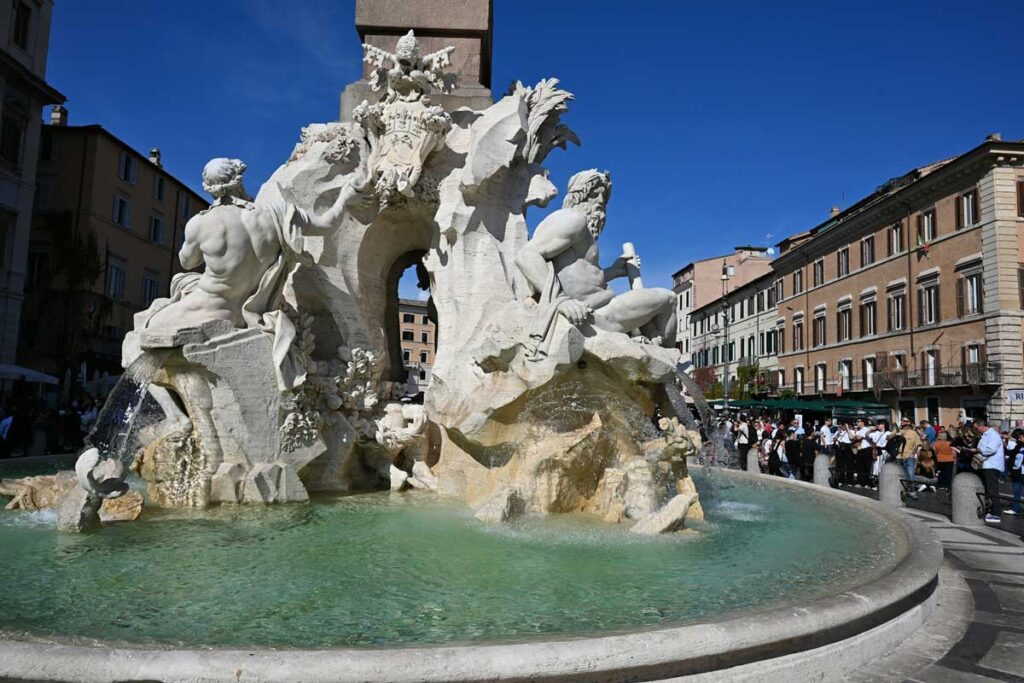
The Fountain of the Four Rivers (Fontana dei Quattro Fiumi) is a Baroque public monument designed by Gian Lorenzo Bernini for Pope Innocent X Pamphilj. It was unveiled on 12 June 1651, and stands at the centre of Piazza Navona in the Navona district of Rome. This guide covers visiting times, admission, transport, accessibility, and practical tips for planning your visit.
Last updated: May 2026. Many guides describe the Danube statue as missing its left index finger — a damage that dated to the 1980s. A major restoration completed in December 2024 reconstructed this missing finger, using historical photographs to restore it precisely. The seven-month, €309,000 restoration, funded by the PNRR Caput Mundi programme, also cleaned, consolidated, and re-waterproofed the entire fountain. The monument is now in its best condition in decades. Any guide describing damage or scaffolding at the fountain is out of date.
Quick facts
| Detail | Information |
|---|---|
| Location | Piazza Navona, 00186 Roma |
| Nearest address for sat-nav | Piazza Navona, Roma |
| Access | Open 24 hours a day, every day of the year |
| Admission | Free |
| Nearest bus lines | 40, 46, 62, 64, 87, 116, 492 |
| Nearest Metro | Spagna (Line A) or Barberini (Line A), both ~20 min walk |
| Parking | No parking available; ZTL zone |
| Typical time at the fountain | 20–30 minutes |
| Typical time in Piazza Navona | 45–90 minutes |
Fountain of the Four Rivers visiting times
The fountain is a public monument in an open piazza and is accessible at any hour of the day or night, every day of the year. There are no opening or closing times, no tickets, and no advance booking of any kind. The piazza is at its quietest in the early morning (before 9am) and late evening (after 9pm). Midday and weekend afternoons are the busiest periods.
The fountain is illuminated at night, making an evening visit a practical and distinctive alternative to daytime. The light on the travertine and marble is particularly effective after dark.
5 great Rome experiences to book
- 🏛️ Skip the queues on a small group tour of the Vatican, Sistine Chapel and St Peter’s.
- 🍝 Discover the tastes of Trastevere on an expert-led food tour.
- 💀 See Rome’s darker side on a combo tour of the catacombs and Capuchin Crypt.
- 👩🍳 Learn how to make fettuccine, ravioli and tiramisu at a hands-on Roman cooking class.
- 🖼️ Explore a quieter side of the city on a small group tour of the Villa Borghese Gallery and Gardens.
Fountain of the Four Rivers admission
The fountain and Piazza Navona are entirely free to visit. No tickets, passes, or booking are required.
The Roma Pass is Rome’s main city tourism card, available for 48 or 72 hours. It covers unlimited use of public transport (bus, tram, Metro) and provides free or discounted entry to participating museums and monuments. Since the fountain itself is free and outdoors, the pass’s cultural benefits apply to nearby paid sites such as the Capitoline Museums and the Colosseum rather than to the fountain directly. Details and current pricing are at romapass.it.
Visiting times and admission status were checked and last verified in May 2026.
Why book the Roma Pass for your visit?
- Free entry to top attractions: Enjoy complimentary admission to many of Rome’s leading museums and archaeological sites with a Roma Pass.
- Public transport included: Use buses, trams and the metro across the city without needing separate tickets throughout the pass validity.
- Flexible duration options: Choose between 48-hour or 72-hour passes to suit how long you’re exploring Rome’s sights.
- Skip-the-line entry: Access select sites faster with priority or skip-the-line benefits where available.
- Cost-effective sightseeing: Save money compared with buying individual tickets, especially if you plan to visit several museums and landmarks.
How to get to the Fountain of the Four Rivers
Piazza Navona is in the heart of the historic centre (centro storico) of Rome and is best reached on foot or by bus. There is no Metro station within comfortable walking distance; the nearest are Spagna and Barberini (both Line A), each approximately 20 minutes on foot.
By bus: Several lines serve the area. Bus 116 is the electric minibus that runs through the narrow streets of the centro storico and stops close to the piazza. Lines 40, 46, 62, 64 serve Corso Vittorio Emanuele II, one block south of the piazza. Lines 87 and 492 also run nearby. Use the Roma Mobilità journey planner for a route from your starting point.
On foot: From the Pantheon (10 minutes north-west), from Campo de’ Fiori (10 minutes south), or from Piazza Venezia (15 minutes east).
Parking near the Fountain of the Four Rivers
Driving to Piazza Navona is not practical. The entire area is a ZTL (Zona a Traffico Limitato — restricted traffic zone), meaning private vehicles are prohibited except for residents with permits. Cameras enforce this automatically, and fines for non-residents are substantial.
Visitors arriving by car should park outside the ZTL — the nearest large parking areas are at Parcheggio Villa Borghese, Parcheggio Gianicolo, or Parcheggio della Lungara — and continue by bus or on foot. Alternatively, park at a Metro station on the outskirts of the city (such as Anagnina or Battistini) and take public transport in.
How long to spend at the Fountain of the Four Rivers
The fountain itself rewards around 20 to 30 minutes for a careful look at all four river figures, the obelisk, and the animals and plants carved into the travertine base. Allow additional time to walk around the full perimeter and view the fountain from different angles.
Piazza Navona as a whole — including its two other fountains, the church of Sant’Agnese in Agone, and the surrounding palaces — typically takes 45 to 90 minutes depending on how much of the surroundings you explore.
Accessibility at the Fountain of the Four Rivers
Piazza Navona is entirely flat, step-free, and accessible at all times. The piazza is a large, open, paved space with no barriers between the entrance streets and the fountain. The perimeter of the fountain can be reached on all sides without steps. Visitors using wheelchairs, mobility aids, or pushchairs will find the piazza fully navigable.
There are no dedicated accessible toilets within the piazza itself. The nearest public facilities are in nearby cafés and restaurants; some charge a small fee for non-customers. The Roma InfoPoint at Piazza Navona can provide guidance on nearby accessible facilities.
The Fountain of the Four Rivers: what to see
The fountain rests on a hollowed-out travertine cliff through which water flows, supporting a 16-metre granite obelisk that rises to 30 metres total when the base and the bronze dove at the apex are included. The obelisk was originally made during the reign of Emperor Domitian (1st century AD), later moved to the Circus of Maxentius on the Appian Way, and re-erected here on the orders of Innocent X.
The four river personifications are colossal marble figures, each representing one of the four major rivers of the continents where Christianity had spread at the time:
The Nile (Africa), by Giacomo Antonio Fancelli, has a veiled head — at the time of construction, the source of the Nile was unknown. It is accompanied by a lion and a palm tree.
The Danube (Europe), by Antonio Raggi, represents the continent with a horse. The left index finger, missing since the 1980s, was reconstructed during the December 2024 restoration using historical photographs to verify its exact position.
The Ganges (Asia), by Claude Poussin, holds a long oar representing the river’s navigability, and is accompanied by a dragon.
The Río de la Plata (Americas), by Francesco Baratta, has one arm raised, with an armadillo beside it. Popular legend — almost certainly invented after the fact — holds that the arm is shielding the figure from a possible collapse of Borromini’s church of Sant’Agnese opposite; the Nile’s veil is said to be turned away from it for the same reason.
The bronze dove at the top of the obelisk is the emblem of the Pamphilj family, the dynasty of Innocent X who commissioned the work.
The two other fountains in Piazza Navona: At the southern end is the Fontana del Moro (Moor’s Fountain), originally by Giacomo della Porta (1575); Bernini later added the central figure of a Moor wrestling a dolphin. At the northern end is the Fontana del Nettuno (Fountain of Neptune), also begun by Giacomo della Porta (1574) but left unfinished for three centuries; the Neptune group was added in 1878 by Antonio Della Bitta.
Sant’Agnese in Agone — the church directly facing the central fountain — was designed by Francesco Borromini and completed by Carlo Rainaldi in the 1660s. Entry is free; check opening times before visiting as it is an active church.
Practical visitor tips
| Tip | Detail |
|---|---|
| Visit early morning or late evening | The piazza is at its busiest between 10am and 7pm, particularly on weekends. Arriving before 8:30am or after 9pm allows a significantly quieter experience. The fountain is lit after dark. |
| Walk the full perimeter | Each of the four river figures faces a different direction and has different sculptural details. Walking around the entire fountain — close up, then from further back — is the best way to appreciate it. |
| Look for the reconstructed finger | The left index finger of the Danube figure (Europe, with the horse) was reconstructed in the December 2024 restoration. It had been missing for roughly 40 years. |
| Watch for the street market context | Piazza Navona hosts street artists, portrait painters, and souvenir stalls throughout the day. These are part of the piazza’s traditional character but can make close-up photography more difficult in the busiest periods. |
| Café seating in the piazza is expensive | Cafés and restaurants around Piazza Navona charge a significant premium for table service. If you want a coffee or drink, side streets one block away offer the same at standard Roman café prices. |
Frequently asked questions about the Fountain of the Four Rivers
| Question | Answer |
|---|---|
| Is the Fountain of the Four Rivers free to visit? | Yes. It is a public monument in an open piazza and is entirely free to visit at any time of day or night, with no tickets or booking required. |
| What are the opening hours of the Fountain of the Four Rivers? | The fountain has no opening or closing hours. Piazza Navona is an open public space accessible 24 hours a day, every day of the year. |
| Is the Fountain of the Four Rivers suitable for children? | Yes. The piazza is flat, step-free, and open. The sculptural details — the animals, the veiled Nile, the obelisk — tend to engage children well. Keep young children close; the fountain basin has no barrier. |
| Can you swim in the Fountain of the Four Rivers? | No. Swimming in Rome’s public fountains is illegal and carries a significant fine. This is enforced by regular police patrols of Piazza Navona. |
| What is the obelisk above the fountain? | The Obelisco Agonale: a 16-metre granite obelisk originally made during the reign of Emperor Domitian (1st century AD), later moved to the Circus of Maxentius on the Appian Way, and restored and re-erected here for Pope Innocent X in 1651. It is crowned by a bronze dove, the symbol of the Pamphilj papal family. |
Things to do near the Fountain of the Four Rivers
Sant’Agnese in Agone – The Baroque church directly opposite the fountain, designed by Francesco Borromini, is free to enter and is the building from which popular legend says the Nile and Río de la Plata statues avert their gaze. Check current opening times before visiting.
Palazzo Braschi and Museo di Roma – On the southern edge of the piazza, the late 18th-century Palazzo Braschi houses the Museo di Roma, which holds paintings, sculptures, and decorative arts documenting Roman life from the medieval period to the 19th century. Entry charges apply.
The Pantheon – Around 10 minutes on foot north-east of the piazza, the Pantheon is one of the best-preserved buildings of ancient Rome (~125 AD). Entry costs €5; advance time-slot booking is required at pantheonroma.com.
Basilica of Saint Mary of Minerva – Around 10 to 15 minutes on foot east of the piazza, the only Gothic interior in Rome contains Michelangelo’s Christ the Redeemer, the tomb of St Catherine of Siena, and the tomb of Fra Angelico.
Campo de’ Fiori – Around 10 minutes on foot south-west, Campo de’ Fiori has a daily morning market and is surrounded by bars and restaurants popular with both visitors and Romans.
What to visit tomorrow: historic fountains and water gardens within two hours of Rome
Trevi Fountain (Fontana di Trevi), Rome — Around 20 minutes on foot from Piazza Navona, the Trevi Fountain (1762, Nicola Salvi) is the largest and most visited Baroque fountain in Rome. It is free to view from the piazza, though the area is busy at all hours. Note: a new timed-entry system for the immediate Trevi Fountain piazza began in 2024; check turismoroma.it for current regulations.
Villa d’Este, Tivoli — Around 45 minutes east of Rome by car, the UNESCO-listed garden of Villa d’Este contains hundreds of Renaissance and Mannerist fountains fed by the River Aniene, including the Fountain of the Organ, the Avenue of a Hundred Fountains, and the Oval Fountain. Entry charges apply.
Villa Lante, Bagnaia (near Viterbo) — Around 1 hour 15 minutes north of Rome, Villa Lante is a late Renaissance garden considered one of the finest examples of Italian garden design. Its central cascade and sequence of water terraces lead from a wooded hillside down to a formal parterre. Entry charges apply.
Fontana Maggiore, Perugia — Around 2 hours north of Rome, the 13th-century Fontana Maggiore in the centre of Perugia is one of the finest medieval fountains in Italy, with sculpted reliefs by Nicola and Giovanni Pisano. It stands at the heart of Perugia’s historic centre. Free to view.
Villa Aldobrandini water theatre, Frascati — Around 30 minutes south-east of Rome, the grounds of Villa Aldobrandini contain a celebrated Baroque water theatre fed by the Alban Hills. The gardens are accessible on weekdays with a free permit from the tourist office in Frascati.
More Rome travel
Other Rome travel guides on Planet Whitley include:
- Guides to ancient sites in Rome: The Temple of Vesta in the Roman Forum, the Pantheon, the Baths of Caracalla, Castel Sant’Angelo and Circus Maximus.
- Guides to Rome’s most spectacular churches: The Basilica of Saint Mary of Minerva and the Church of St Ignatius of Loyola.
- Why a private tour of the Colosseum and Roman Forum is often the best choice.
- Plan your visit to the Palazzo Altemps in Rome.
- Rome cooking class vs food tour: Which is the best to book?
