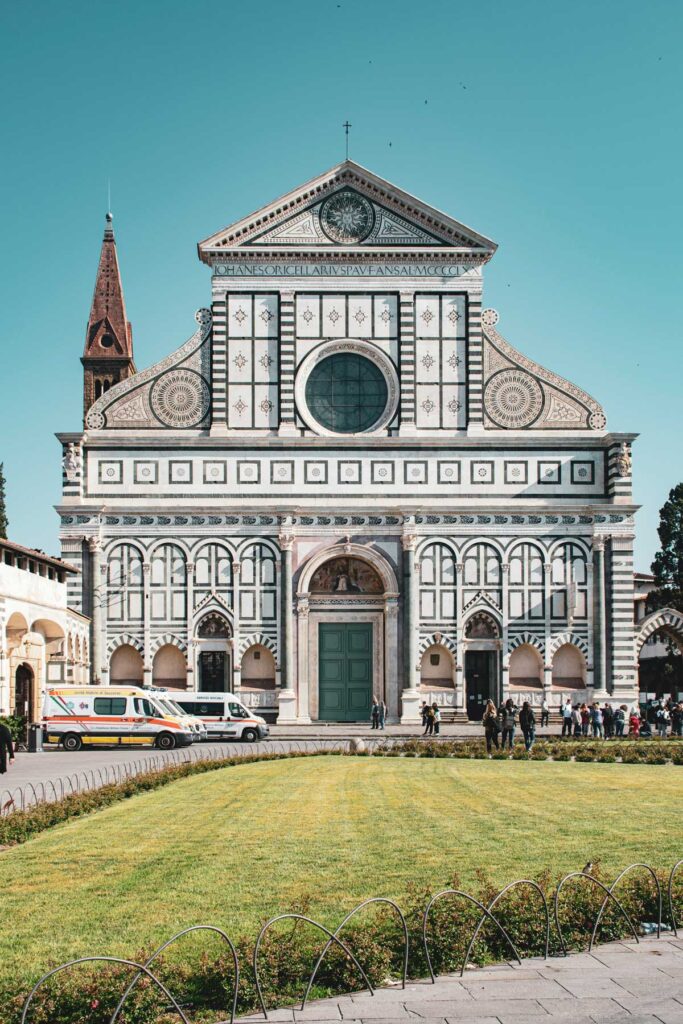
The Basilica of Santa Maria Novella is the principal Dominican church of Florence and one of the most artistically rich interiors in the world, holding works by Masaccio, Giotto, Brunelleschi, Ghirlandaio, Filippino Lippi, and Botticelli.
This guide was updated in June 2026. The full admission price is €7.50 — several aggregators and guides still show €5 or €6. Opening hours vary significantly by day: the Friday/civil holiday opening is 11:00 (two hours later than Monday–Thursday), and on Sundays the complex opens only at 13:00. The Chapel of the Pura is temporarily closed for maintenance. You can book through GetYourGuide in advance.
Quick facts
| Detail | Information |
|---|---|
| Address | Piazza Santa Maria Novella 18, 50123 Florence, Tuscany, Italy. |
| Hours: Mon–Thu | 09:00–17:30 |
| Hours: Fri and civil holidays | 11:00–17:30 |
| Hours: Sat and eves of religious holidays | 09:00–17:00 |
| Hours: Sun and religious holidays | 13:00–17:00 |
| Last admission | One hour before closing |
| Closed to visitors | Good Friday; Holy Saturday |
| Full ticket | €7.50 |
| Reduced (ages 11–18) | €5 |
| Under 11 | Free |
| Disabled visitors + carer | Free |
| Florence residents | Free (with valid ID) |
| Groups: earphones required from | 6+ people |
| Chapel of the Pura | Temporarily closed for maintenance |
| Nearest station | Santa Maria Novella (2-minute walk) |
| Nearest bus | Multiple stops on Via della Scala and Piazza dell’Unità |
| Typical visit | 1–1.5 hours |
Santa Maria Novella opening hours
The visiting schedule has four different configurations depending on the day:
- Monday to Thursday: 09:00–17:30
- Friday and civil public holidays: 11:00–17:30 (opens two hours later — frequently missed by visitors)
- Saturday and eves of religious holidays: 09:00–17:00
- Sunday and religious holidays: 13:00–17:00
Last admission is one hour before closing in every case. The basilica is closed to tourists on Good Friday and Holy Saturday (open for prayer only). Religious holidays include 1 January, 6 January, 15 August, 1 November, 8 December, and 25 December; these follow the Sunday schedule.
Santa Maria Novella admission prices
The full ticket is €7.50, confirmed on the official tickets page. Several well-visited aggregators and guides still list €5 (now the reduced/child price) or €6 as the adult price.
| Category | Price |
|---|---|
| Full ticket | €7.50 |
| Reduced (ages 11–18) | €5 |
| Under 11 | Free |
| Florence residents | Free (valid identity card required) |
| Disabled visitors + one carer | Free |
| Members of religious orders / diocesan clergy | Free |
| Tour guides (with valid licence) | Free |
| Group leaders (1 free per 15 people) | Free |
| ICOM, ICOMOS, ICCROM members | Free |
| Special events ticket | €12 (includes Basilica access) |
Tickets can be purchased at the basilica ticket office on the day without a reservation. For advance booking, use the Museo di Santa Maria Novella online portal. Book through GetYourGuide to confirm your time.
Why visit Santa Maria Novella?
- 🏛️ Masaccio’s Trinity (1427): The first painting in Western art to demonstrate correct single-point perspective — a work so radical that Brunelleschi himself is thought to have contributed the architectural design. It is on the wall of the left nave and is one of the most studied paintings in art history.
- 🎟️ One ticket covers the Basilica, Museum, and all the Cloisters: The €7.50 admission includes the entire complex — the Green Cloister, the Spanish Chapel, the Cloister of the Dead, the Ubriachi Chapel, and the Refectory — not just the basilica nave.
- 🌿 Ghirlandaio’s Tornabuoni Chapel frescoes (1485–1490): The most complete surviving fresco cycle by Ghirlandaio, covering the Life of the Virgin and the Life of John the Baptist. The chapel behind the high altar is the visual climax of the Basilica visit.
- 📜 Two crucifixes by Brunelleschi and Giotto in the same building: Brunelleschi carved his crucifix specifically to challenge what he considered the peasant-like quality of Giotto’s earlier crucifix at Santa Croce. Both are here, allowing a direct comparison that sparked one of the most famous artistic arguments of the Renaissance.
- 💰 Free for Florence residents and under-11s: Children pay nothing; residents of the municipality enter free on presentation of a valid Italian identity card.
How to get to Santa Maria Novella
By train, Stazione di Santa Maria Novella is a 2-minute walk from the basilica entrance. The station is on the main Florence–Rome and Florence–Milan lines; the piazza is immediately in front of the main exit.
By bus (ATAF), multiple routes terminate or pass through the area around the station and Piazza dell’Unità. Bus C2 connects the basilica area with the Uffizi, Bargello, and Piazza Santa Croce.
On foot from the city centre, the basilica is 12 minutes’ walk from the Duomo heading west along Via dei Cerretani and Via Panzani. From Piazza della Repubblica, it is 10 minutes.
Parking at Santa Maria Novella
There is no dedicated parking at the basilica. The nearest practical option is Parcheggio SMN (Piazza della Stazione), immediately adjacent to the train station — a multi-storey car park at the entrance to the ZTL. From there, the basilica is a 2-minute walk. ZTL restrictions apply to the surrounding streets. Arriving by train from anywhere in Tuscany is significantly more convenient than driving.
5 great Florence experiences to book
- 🏛️ Cover Florence in a day – including the Duomo, Uffizi and skip-the-line tickets for Michelangelo’s David.
- 🍝 Learn how to make pasta the Tuscan way at a cooking class with unlimited wine.
- 🎨 On a guided tour of the Uffizi Gallery, discover the detail in the Renaissance masterpieces.
- 🗿 Discover much more than David on a guided tour of the Galleria dell’Accademia.
- 🍷 Take a 4WD Tuscan wine safari – with several winery tastings and a three-course lunch.
How long to spend at Santa Maria Novella
Allow 1 to 1.5 hours for a thorough visit. The Basilica interior takes 30–45 minutes; the Museum and Cloisters add another 30–45 minutes. Visitors who focus only on the key highlights (Masaccio’s Trinity, Brunelleschi’s Crucifix, the Tornabuoni Chapel, and Filippino Lippi’s Strozzi Chapel) can complete the basilica in under 30 minutes, but the Spanish Chapel in particular rewards a longer visit.
Accessibility at Santa Maria Novella
The entrance from Piazza Santa Maria Novella is step-free. The basilica floor is largely flat and navigable by wheelchair. Some areas of the cloisters have uneven stone surfaces. No specific lift is confirmed; contact the basilica directly (+39 055 219257) for accessibility queries in advance. Disabled visitors and one companion enter free. Baby changing facilities are available inside the complex.
What to see at Santa Maria Novella
Masaccio’s Trinity (c.1427) hangs on the left nave wall — the first painting in Western art to demonstrate mathematically correct single-point perspective. Contemporaries described it as if a hole had been made in the wall. The Trinity occupies the upper section; a skeleton with a memento mori inscription is below.
Giotto’s Crucifix (c.1290–1300) hangs at the nave centre in its original position — one of the earliest crucifixes to show Christ as a human figure in suffering rather than a rigid icon.
Brunelleschi’s Crucifix is in the Gondi Chapel (left transept). Carving it was Brunelleschi’s deliberate reply to what he considered the crudeness of Giotto’s version. The two can be compared from the nave floor — a direct confrontation between two Renaissance temperaments.
The Tornabuoni Chapel (Cappella Maggiore) behind the high altar is frescoed by Ghirlandaio (1485–1490) with Life of the Virgin and Life of John the Baptist cycles, incorporating contemporary Medici-circle portraits. The young Michelangelo trained in Ghirlandaio’s workshop during this commission.
The Strozzi Chapel (left transept) holds Filippino Lippi’s frescoes (1489–1502) of Saints Philip and John the Evangelist — among the most architecturally ambitious Florentine frescoes of the late 15th century.
The Spanish Chapel in the Museum section has Andrea di Bonaiuto’s 14th-century frescoes covering all four walls — a visual encyclopedia of Dominican theology including early portraits of Dante and Boccaccio.
The Green Cloister is named for the terra verde pigment Paolo Uccello used in his Old Testament frescoes (c.1430s). The colours are faded but the architectural imagination remains striking.
Practical tips for visiting Santa Maria Novella
| Tip | Detail |
|---|---|
| Check the specific-day hours | Friday opens at 11:00, not 09:00. Sunday opens at 13:00. June 2026 has multiple date-specific closures. Always check the Alerts section of smn.it before your visit. |
| The ticket price is €7.50, not €5 or €6 | Several guides and aggregators still show the reduced price (€5, for ages 11–18) or the old adult price. The current full adult price is €7.50. |
| Groups of 6+ must use earphones | From 6 people onwards, earphones are mandatory — not 10 or 15 as many sources state. |
| The Chapel of the Pura is closed | Confirmed on the official site as temporarily closed for maintenance until further notice. |
| Book in advance | Walk-in tickets are available at the door. Pre-booking is useful during busy summer periods and guarantees your preferred time slot. |
Santa Maria Novella FAQ
| Question | Answer |
|---|---|
| What is the adult ticket price? | €7.50 full price; €5 reduced (ages 11–18). Several guides and aggregators still show €5 or €6 for adults — those are now out of date. |
| Why does Friday seem to open late? | Friday and civil public holidays open at 11:00, not 09:00. This is a fixed pattern, not an exception, but it is absent from most guides that list a single opening time. |
| What time does it open on Sundays? | 13:00 on Sundays and religious holidays — the most restricted opening of the week. Visitors planning a Sunday morning visit will find it closed. |
| Is the Chapel of the Pura open? | No. It is temporarily closed for maintenance. No confirmed reopening date is stated on the official site. |
| Does the ticket cover the cloisters and museum? | Yes — the single €7.50 ticket covers the Basilica, the Green Cloister, Spanish Chapel, Cloister of the Dead, Ubriachi Chapel, and Refectory. |
Things to do near Santa Maria Novella
Piazza Santa Maria Novella surrounds the basilica and is one of the most elegant squares in Florence. The obelisks on two sides were used as turning posts for the Palio dei Cocchi (chariot races) from the 16th century. The square is freely accessible at all times.
The Officina Profumo-Farmaceutica di Santa Maria Novella is on Via della Scala, 2 minutes south of the basilica. Founded by Dominican friars in the 13th century, it is the world’s oldest pharmacy still in commercial operation — the frescoed rooms, stone counters, and botanical preparations are worth a visit in their own right, even without purchasing.
The Museo Nazionale Alinari della Fotografia is on Piazza Santa Maria Novella and holds one of the world’s largest archives of historical photographs, run by the Alinari Brothers firm founded in 1852. Admission is separate.
Stazione di Santa Maria Novella (the train station) is a significant piece of Italian rationalist architecture designed by Giovanni Michelucci and completed in 1935. The interior is largely intact and worth a deliberate look from a design perspective.
Palazzo Strozzi is 10 minutes’ walk south-east and is Florence’s principal venue for major temporary exhibitions, housed in the finest Renaissance palazzo in the city exterior-wise. Check what is currently showing.
Similar Gothic churches to visit near Florence
The Basilica di Santa Croce, Florence is the principal Franciscan church of Florence and the companion to Santa Maria Novella as the two great mendicant churches of the city. It holds the tombs of Michelangelo, Dante (cenotaph), Galileo, and Machiavelli, alongside Donatello’s gilded Annunciation and Cimabue’s restored Crucifix. Around 20 minutes’ walk south-east.
The Basilica di San Lorenzo, Florence is 10 minutes’ walk east and is the Medici family church designed by Brunelleschi. The Old Sacristy, the Medici Chapels behind it, and Michelangelo’s New Sacristy form the most comprehensive Medici artistic programme in the city.
Siena Cathedral (Duomo di Siena) is around 90 minutes south by bus or car. Its Gothic interior, marble inlay floor, Nicola Pisano’s pulpit, and Ghirlandaio’s Piccolomini Library together represent a comparable richness to Santa Maria Novella. See the dedicated guide in this series.
The Basilica di San Miniato al Monte, Florence is 30 minutes on foot up the hill east of the Arno (or 10 minutes by bus). The 11th-century Romanesque façade in green and white marble and the painted wooden ceiling in the apse are outstanding.
Orvieto Cathedral is around 1.5 hours south-west by train or car. Its Gothic façade mosaic and the Signorelli frescoes in the Chapel of San Brizio — begun in 1499 — are among the most important fresco cycles in central Italy outside Florence.
More Tuscany travel
Other Tuscany travel guides on Planet Whitley include:
- Why a Pisa food tour is a great way to explore beyond the Tower.
- How to visit two Chianti Classico wineries from Florence in one afternoon.
- Learning to make pasta in Florence.
- How long are the queues to see Michelangelo’s David?
- Florence attraction guides: Palazzo Vecchio, Bargello Museum, Medici Chapels, Museo de Medici, Uffizi Gallery, Museo Galileo, Florence Synagogue and Museum, Pitti Palace and Boboli Gardens.