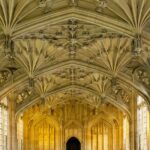
The Clarendon Building is an early 18th-century Baroque building at the corner of Broad Street and Catte Street in Oxford, designed by Nicholas Hawksmoor and completed in 1715. Originally built to house the Oxford University Press, it is now used as administrative offices for the Bodleian Libraries and the University of Oxford. The exterior and the adjoining Clarendon Quadrangle are viewable freely; the interior is not open to the public. This guide covers what you can see, how to approach a visit, and how the building fits into the wider Broad Street architectural ensemble.
My personal Oxford recommendation
Oxford is a city of stories. You miss a lot of the walking around independently. This is a place where, much more than usual, it’s worth taking a walking tour.
I took the excellent Official Oxford University and City walking tour. It gave a great grounding on the city’s history, quirky university traditions and fascinating details on buildings you may otherwise miss. I recommend it, but there are other Oxford walking tours to choose from if you’d prefer a different theme.
Last updated: June 2026. The key planning point: the interior is not open to the public. Some guides describe the Clarendon Building as part of the Bodleian touring circuit — it is not included in any public Bodleian tour. The exterior, however, is one of the finest Baroque facades in Oxford and is fully visible from the pavement.
Quick facts
| Detail | Information |
|---|---|
| Address | Broad Street, Oxford, OX1 3BG (corner of Broad Street and Catte Street) |
| Opening hours | Exterior: viewable at all times. Interior: not open to the public |
| Entry price | Free (exterior only) |
| Managed by | Bodleian Libraries / University of Oxford |
| Nearest transit | Oxford station (~15 min walk); multiple bus routes to city centre |
| Parking | No on-site parking; Park & Ride recommended |
| Typical visit length | 10–15 minutes (exterior only) |
Clarendon Building opening hours
The exterior of the Clarendon Building is viewable at all times from Broad Street and from the Clarendon Quadrangle (the courtyard between the Clarendon Building and the Old Bodleian Library).
The interior is not open to the public and is not included in any public Bodleian guided tour. It is used as offices for Bodleian Libraries administrative staff and the Vice-Chancellor’s office.
The Clarendon Quadrangle (entered from Broad Street via a gateway west of the Sheldonian Theatre, or from Catte Street) is generally accessible during daytime hours as part of the Bodleian Library complex.
5 Oxford experiences worth booking
- 🎓 Take an Oxford University walking tour led by an alumni guide.
- ⚡ Explore Oxford’s Harry Potter filming locations on a tour including New College.
- 🚣 Embark on a scenic river cruise along the University Regatta course.
- 🕵️ Discover the Oxford of Morse, Lewis and Endeavour on a themed walking tour.
- 🏰 Hear dark historic tales on a guided visit to Oxford Castle and Prison.
Clarendon Building ticket prices
There is no charge and no ticket required to view the exterior. Entry to the interior is not available to the public.
The Clarendon Building is not included in any Bodleian guided tour and is not part of any commercial city pass scheme.
How to get to the Clarendon Building
The Clarendon Building is on Broad Street, Oxford, at its junction with Catte Street — between the Sheldonian Theatre (to the west) and the Old Bodleian Library gatehouse (to the east). It is directly opposite Blackwell’s bookshop.
By bus and Park & Ride: Multiple routes serve the city centre. Alight at Carfax or St Giles’ and walk a few minutes to Broad Street.
By train: Oxford station is approximately 15 minutes’ walk. Head east through the city centre to Broad Street.
On foot: The building is in the heart of the Bodleian Library complex, 1 minute from the Sheldonian Theatre and 2 minutes from the Weston Library.
Parking
No visitor parking is available near the building. Use the Park & Ride (five sites on Oxford’s main approach roads) or the city-centre car parks at Gloucester Green or Westgate. Broad Street itself is pedestrianised at its eastern end.
Coaches may drop off on Beaumont Street (westbound, opposite the Ashmolean Museum) or St Giles’. Coach parking is not available in the city centre.
How long to spend at the Clarendon Building
Allow 10 to 15 minutes for the exterior. Most visitors view the Clarendon Building as part of a broader exploration of the Broad Street architectural ensemble alongside the Sheldonian Theatre, the Old Bodleian courtyard, the History of Science Museum, and the view to the Radcliffe Camera. A full circuit of these buildings takes around an hour on foot.
Accessibility at the Clarendon Building
Exterior access: The building is viewable from the pavement on Broad Street. The frontage is at pavement level with no steps required to view the façade.
Clarendon Quadrangle access: Level access to the quadrangle is available from Broad Street via a gateway to the west of the Sheldonian Theatre. Entry from Catte Street involves four stone steps. Entry from the gateway on Broad Street (near the Weston Library shop entrance) is level.
The interior is not accessible to the public.
What to see at the Clarendon Building
The façade
The Clarendon Building is a Baroque building in Portland stone, constructed in a restrained English Baroque style characteristic of its architect. The main entrance on Broad Street is framed by a large Doric portico — a columned porch — giving the building a formal, monumental quality appropriate to its original function as the headquarters of one of the world’s oldest academic publishers.
The design was produced by Nicholas Hawksmoor (1661–1736), who is now regarded as one of the most original English architects of the period. Hawksmoor worked closely with Christopher Wren and later with John Vanbrugh; he is best known for the west towers of Westminster Abbey, Christ Church Spitalfields, and Mausoleum at Castle Howard. The Clarendon Building is his only major work in Oxford.
The building was funded largely from the profits of the Earl of Clarendon’s History of the Rebellion — Edward Hyde, 1st Earl of Clarendon, was Charles II’s Lord Chancellor and the author of a royalist history of the Civil War. Rights to this work were assigned to Oxford University, and the profits funded both the building and the early years of the press. The building takes its name from this connection.

The rooftop statues of the nine Muses
The most striking feature, best seen from the pavement on the opposite side of Broad Street, is the row of nine lead statues along the roofline. They represent the nine Muses — the Greek goddesses of the arts and learning — standing at equal intervals across the parapet. The statues were added when the building was completed in 1715 and were originally gilt. Over time the gilding has been lost and the lead has weathered to its current grey colour.
The statues have undergone several restorations, most recently in conservation projects focused on preserving the stonework and statuary using historically compatible materials. They are among the most recognisable decorative features on any building in Oxford.
The Clarendon Quadrangle
The Clarendon Building forms the northern boundary of the Clarendon Quadrangle (often called Schools Quad or Old Quad), the courtyard at the heart of the Old Bodleian Library complex. Entering the quadrangle from the Broad Street gateway gives a different perspective on the building — its south elevation, less formal than the main Broad Street façade, faces the courtyard. The quadrangle itself is free to walk through and is surrounded by the Old Bodleian’s library ranges on three sides, with the Tower of the Five Orders at the south side.
Historical note: Oxford University Press
The Clarendon Building served as the headquarters of Oxford University Press from its completion in 1715 until 1830, when the press outgrew the building and moved to its current site on Great Clarendon Street in Jericho. Before this building, the press had operated from the Sheldonian Theatre, whose printing functions the Clarendon Building took over. The press has been operating continuously since 1478, making it the world’s oldest continuously operating university press.
After the press relocated, the building served various university administrative functions before its current use as Bodleian Libraries offices.
Practical visitor tips
| Tip | Detail |
|---|---|
| The interior is not accessible | The Clarendon Building is an administrative office. Attempting to enter will be refused. Viewing is exterior only. |
| Best viewed from across Broad Street | Standing on the north side of Broad Street (in front of Blackwell’s bookshop or the History of Science Museum) gives the best view of the Doric portico and the nine Muses on the roofline. |
| Part of a wider Broad Street circuit | The Clarendon Building is most rewarding seen as part of the broader ensemble with the Sheldonian Theatre (immediately west), the Old Bodleian courtyard (immediately east), the History of Science Museum (east), and the distant Radcliffe Camera to the south. Allow an hour for the full circuit. |
| Bodleian Library tours do not include it | The 30-minute, 60-minute, and 90-minute Bodleian guided tours pass through the Old Bodleian courtyard (which the Clarendon Building faces) but do not enter the Clarendon Building itself. |
| Heritage Open Days | The building may open to the public during Heritage Open Days (typically the second weekend of September). Check heritageopendays.org.uk for the current year’s programme. |
Frequently asked questions about the Clarendon Building
| Question | Answer |
|---|---|
| Can you go inside the Clarendon Building? | No. The interior is not open to the public. It is used as administrative offices for the Bodleian Libraries and the University of Oxford. |
| Is the Clarendon Building part of the Bodleian Library tours? | No. Bodleian Library guided tours do not enter the Clarendon Building. The building is part of the wider Bodleian complex but not on the public tour circuit. |
| Is visiting the Clarendon Building free? | Yes — to view the exterior. There is no charge and no ticket required. |
| Who designed the Clarendon Building? | Nicholas Hawksmoor, completed 1715. It is his only major building in Oxford. |
| What are the statues on the roof? | The nine lead statues on the roofline represent the nine Muses — the Greek goddesses of the arts. They were added when the building was completed in 1715 and have been restored several times since. |
Things to do near the Clarendon Building
- Sheldonian Theatre (~1 minute west, Broad Street) — Wren’s 1669 ceremonial hall, open to visitors on most days with cupola views over the city. Admission charged; check open days before visiting.
- History of Science Museum (~1 minute east, Broad Street) — The world’s oldest surviving purpose-built museum, with a free collection of historic scientific instruments.
- Old Bodleian Library — Weston Library and tours (~2 minutes east) — The Weston Library has free exhibitions; guided tours give access to the Divinity School, Convocation House, Duke Humfrey’s Library, and the Radcliffe Camera.
- Blackwell’s Bookshop (~2 minutes north, Broad Street) — One of the most famous academic bookshops in the world, occupying several buildings at 48–51 Broad Street. The Norrington Room in the basement is a remarkable space.
- Martyrs’ Memorial (~3 minutes’ walk northwest, St Giles’) — The 1843 Victorian Gothic memorial to the Oxford Martyrs, at the junction of St Giles’ and Beaumont Street.
What to visit tomorrow: similar Baroque and early Georgian buildings within two hours
- Blenheim Palace, Woodstock (~10 miles north) — Broadly contemporary with the Clarendon Building, designed by John Vanbrugh (with Hawksmoor’s assistance) and completed in 1722. The finest English Baroque building. UNESCO World Heritage Site. Admission charged.
- St Philip’s Cathedral, Birmingham (~60 miles northwest) — Thomas Archer’s 1715 Baroque church, completed in the same year as the Clarendon Building. Now Birmingham Cathedral. Free to enter.
- Wren Library, Trinity College, Cambridge (~80 miles northeast) — Christopher Wren’s library at Trinity College Cambridge (1695), a peer building to the Clarendon and a fine example of the English classical tradition. Open to the public on selected afternoons; check Cambridge’s website before visiting.
- Senate House, Cambridge (~80 miles northeast) — James Gibbs’s 1730 ceremonial hall, broadly comparable in function to the Sheldonian and the Clarendon Building complex. Open during graduation ceremonies; exterior viewable at all times.
- Queen’s College, Oxford (~10 minutes’ walk, High Street) — The 18th-century rebuilding of Queen’s College gives a full Baroque quadrangle composition — the most complete in Oxford — and is open to visitors at set times. Check the college website for current opening.
More Oxfordshire travel
Other Oxfordshire travel guides on Planet Whitley include:
- Enjoy the highlights of Oxford University, including the Ashmolean Museum, the Pitt Rivers Museum, the Museum of Natural History, the History of Science Museum, the Bridge of Sighs and the Sheldonian Theatre.
- 9 reasons to visit Oxford, England.
- Shudder at dark tales of incarceration at Oxford Castle and Prison.
- Oxford city centre attraction guides: The Museum of Oxford, the Story Museum, the Martyrs’ Memorial and Carfax Tower.
- The quietest times to visit Blenheim Palace.