Oxford Botanic Garden is the oldest botanic garden in the United Kingdom, established in 1621. It’s on Rose Lane beside the River Cherwell in central Oxford, managed by the University of Oxford. It holds over 5,000 different plant species across a walled garden, glasshouses, and riverside grounds, and operates alongside the separately located Harcourt Arboretum in Nuneham Courtenay. This guide covers opening hours, admission, transport, parking, what to see, accessibility, and practical tips.
My personal Oxford recommendation
Oxford is a city of stories. You miss a lot of the walking around independently. This is a place where, much more than usual, it’s worth taking a walking tour.
I took the excellent Official Oxford University and City walking tour. It gave a great grounding on the city’s history, quirky university traditions and fascinating details on buildings you may otherwise miss. I recommend it, but there are other Oxford walking tours to choose from if you’d prefer a different theme.
Last updated: June 2026. Note that opening hours change four times per year — the visit page states “10am–5pm daily” which applies only to spring and autumn; summer hours are longer and winter hours shorter. Many guides reproduce only the spring/autumn hours, which is misleading in summer and winter. The garden also runs a timed-entry booking system; each transaction carries a £1 booking fee not shown on headline price lists.
Quick facts
| Detail | Information |
|---|---|
| Address | Rose Lane, Oxford, OX1 4AZ |
| Summer hours (May–August) | Daily, 10:00am–6:00pm; last entry 5:00pm |
| Spring/Autumn hours (March–April, September–October) | Daily, 10:00am–5:00pm; last entry 4:00pm |
| Winter hours (November–February) | Daily, 10:00am–4:00pm; last entry 3:00pm |
| Adult admission | £9.00 (+ £1 booking fee per transaction) |
| Nearest transit | High Street / Queen’s Lane bus stops (~5 min walk) |
| Parking | No on-site parking; nearest is St Clement’s car park |
| Typical visit length | 1.5–3 hours |
Oxford Botanic Garden opening hours
The garden is open every day of the year on a seasonal schedule:
| Season | Months | Hours | Last entry |
|---|---|---|---|
| Summer | May–August | 10:00am–6:00pm | 5:00pm |
| Spring & Autumn | March–April, September–October | 10:00am–5:00pm | 4:00pm |
| Winter | November–February | 10:00am–4:00pm | 3:00pm |
The glasshouses or specific parts of the site may occasionally close for maintenance, education groups, or events. Contact the office in advance if you want to confirm a specific date: 01865 610 305 or admin@obg.ox.ac.uk.
Opening hours and prices were checked on the official OBGA website and the Oxford ticketing system and last updated in June 2026.
5 Oxford experiences worth booking
- 🎓 Take an Oxford University walking tour led by an alumni guide.
- ⚡ Explore Oxford’s Harry Potter filming locations on a tour including New College.
- 🚣 Embark on a scenic river cruise along the University Regatta course.
- 🕵️ Discover the Oxford of Morse, Lewis and Endeavour on a themed walking tour.
- 🏰 Hear dark historic tales on a guided visit to Oxford Castle and Prison.
Oxford Botanic Garden ticket prices
| Ticket type | Price |
|---|---|
| Standard Adult Day Ticket | £9.00 |
| Concession: Student | £7.20 |
| Concession: Oxford University alumni | £7.20 |
| Concession: Over-65 | £7.20 |
| Disabled visitor (including one accompanying carer) | £1.00 |
| Children under 16 (with a paying adult family member) | Free |
| University of Oxford staff and students | Free (valid University ID required) |
| Friends of OBGA members | Free (valid membership card required) |
Important: Each online transaction carries a £1 booking fee in addition to the ticket prices above. This applies regardless of how many tickets are in the transaction.
Children under 16 do not need to book a ticket when visiting with a paying family member. Under-16s visiting as part of a tour or school group must purchase a student ticket.
Tickets can be purchased at the door on the day, or booked online in advance at tickets.ox.ac.uk. Advance booking is recommended during busy periods to guarantee entry. All tickets are non-transferable and non-refundable.
The garden is not included in any commercial city pass scheme. Oxford University staff and students should bring a valid University ID card; the admission desk cannot check membership or staff status without it.
Friends members must bring their physical membership card or email confirmation — staff cannot look up memberships at the door.
How to get to Oxford Botanic Garden
The garden is on Rose Lane, on the south side of High Street, at the junction with Magdalen Bridge. It is next to the River Cherwell and directly opposite Magdalen College.
Walking: From Carfax Tower, walk east along High Street for approximately 11 minutes. From Oxford station, allow 25 minutes on foot.
By bus: Several routes serve the High Street and Queen’s Lane stops, a short walk from the garden entrance — including Park & Ride services. Check the Oxford Bus Company or Stagecoach websites for current routes.
By bike or e-scooter: Cycle racks are located outside the garden. An e-scooter pick-up point is near the High Street steps. Cycling is not permitted inside the garden.
Parking at Oxford Botanic Garden
There is no car park at the Botanic Garden. The nearest car park is St Clement’s Car Park, Oxford City Council, St Clement’s Street, Oxford — a short walk east across Magdalen Bridge. City-centre Park & Ride services are the recommended option for visitors arriving by car.
How long to spend at Oxford Botanic Garden
Allow 1.5 to 3 hours depending on how thoroughly you want to explore. A focused visit to the walled garden and glasshouses takes around 90 minutes. Adding the riverside lower garden and walking more slowly through the planting collections can fill a full half-day. The garden is a pleasant place to sit and read — picnics are permitted and there are plenty of benches.
Accessibility at Oxford Botanic Garden
The site is fully wheelchair accessible. A wheelchair is available for public use but must be booked in advance by calling the ticket office on 01865 610 300.
Toilets (including accessible toilets) and changing facilities are on site.
Dogs are not permitted in the garden, with the exception of assistance dogs.
What to see at Oxford Botanic Garden
The Walled Garden
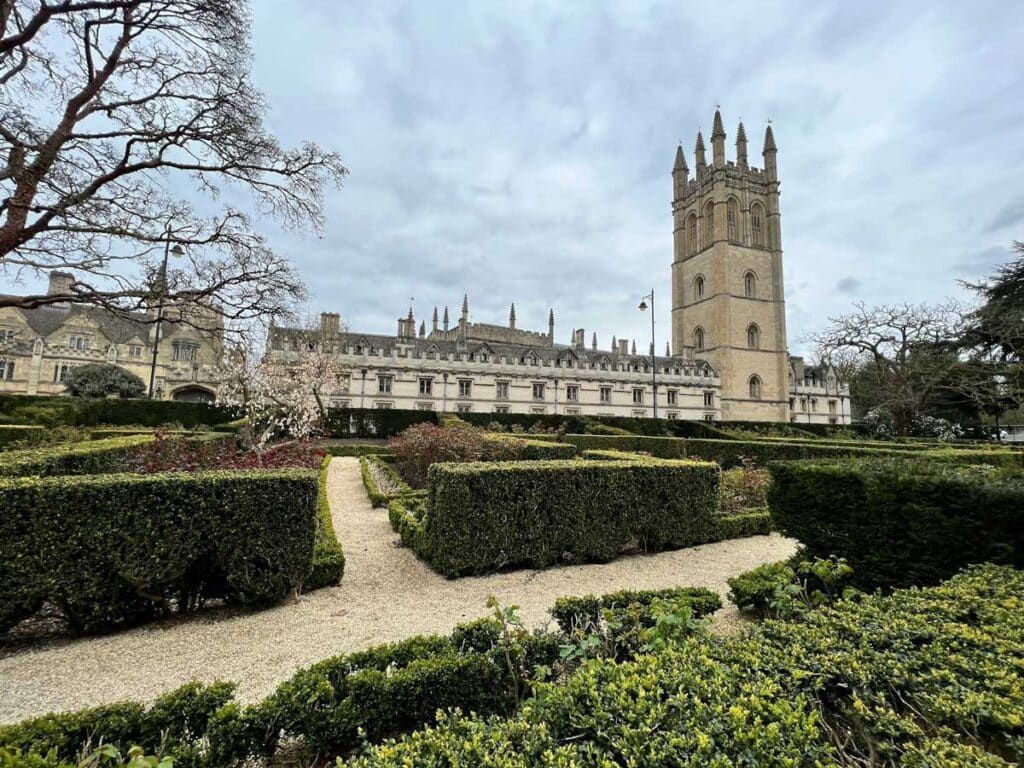
The oldest part of the garden, dating to its foundation in 1621, is enclosed by high limestone walls and divided into formal beds. The original botanic garden was established here as a physic garden — a medicinal plant collection supporting the study of medicine at the University. This purpose shaped the layout and the choice of species for centuries.
Today the Walled Garden contains:
Taxonomic (family) beds — plants arranged by botanical family, allowing visitors to see relationships between species across the plant kingdom. The layout is designed for scientific study as much as for aesthetic display.
The Literary Garden — a planting of species associated with the works of Philip Pullman (his His Dark Materials trilogy is set partly in Oxford, and the Botanic Garden appears in the concluding scenes). Specific plants referenced in the novels are labelled, making this a draw for Pullman readers.
The Medicinal Collection — historic and contemporary medicinal plants, tracing the garden’s origins as a physic garden and its ongoing relevance to pharmacological research.
Champion trees — several trees within the garden are recorded as the largest of their species. A yew tree planted in 1645 is among the oldest living specimens in the garden.
The Lower Garden
Running along the River Cherwell and bordered by Christ Church Meadow, the Lower Garden contains several ornamental collections:
The Herbaceous Border — one of the garden’s most visually dramatic features, a long double border planted for colour and sequence across the season.
The Rock Garden — a large rockery planted with alpine and mountain species from various world regions, maintained in the tradition of early 20th-century rock gardening.
‘Plants That Changed the World’ border — a curated planting of economically significant species, tracing the impact of plants on human history through food, medicine, industry, and culture.
Water features — the lower garden includes water plantings and is bordered by the Cherwell, visible through gaps in the perimeter planting.
The Glasshouses
The garden has seven display glasshouses representing different climatic environments. Visitors move through tropical, desert, and alpine conditions in sequence:
- Tropical rainforest house — tall trees, epiphytes, and high humidity
- Lily house — giant Victoria water lilies (Victoria cruziana) in season; one of the most photographed plants in the garden
- Arid house — cacti and succulents from desert environments
- Alpine house — cold-climate species from mountain regions worldwide
- Temperate house — Mediterranean and cool-temperate climate plants
The glasshouses are among the most child-friendly parts of the garden. Occasional partial closures occur for maintenance — check before visiting if a specific house is a priority.
Research and conservation
The Botanic Garden is an active research institution within the University of Oxford. Current research areas include climate adaptation in plants, rare species conservation, and interdisciplinary work connecting botanical science with medicine, technology, and ecology. Conservation work extends to threatened species internationally, including via the Community for the Conservation and Research of Rafflesia (a parasitic plant genus facing extinction).
Activities and events
The garden runs a programme of events throughout 2026, including:
- Chemistry in the Garden — family-friendly science activities
- Houseplant Care — practical courses for adults
- Friends’ Coffee Mornings — first Friday of each month (excluding January and August); open to Friends members
Check the What’s On calendar at obga.ox.ac.uk/whats-on for current listings. Many events require separate booking and some sell out in advance.
Practical visitor tips
| Tip | Detail |
|---|---|
| Hours change four times a year | The visit page states “10am–5pm” but this only applies in spring and autumn. Summer hours run to 6pm (last entry 5pm); winter hours close at 4pm (last entry 3pm). Check before visiting. |
| Book online to guarantee entry in busy periods | Walk-in tickets are available at the door, but the garden recommends booking in advance during peak times. There is a £1 booking fee per online transaction. |
| Bring your Friends card or University ID | Staff cannot look up memberships or University status at the door. Without your card or email confirmation you will be charged the standard admission price. |
| Dogs are not permitted | Assistance dogs excepted. Leave dogs at home or use the nearby Magdalen Bridge and river meadow walks instead. |
| No alcohol on site | Picnics are welcome. Horsebox Coffee is on site for drinks. Please do not bring alcohol. |
Frequently asked questions about Oxford Botanic Garden
| Question | Answer |
|---|---|
| Is Oxford Botanic Garden free? | No. Standard adult admission is £9 (+ £1 booking fee per transaction). Children under 16 are free with a paying adult family member. University of Oxford staff and students, and Friends members, enter free with valid ID. |
| Is the garden open on Sundays? | Yes, every day of the year. Hours vary by season — see the seasonal schedule above. |
| Is there parking at Oxford Botanic Garden? | No. The nearest car park is St Clement’s Car Park on St Clement’s Street. Park & Ride is the recommended option. |
| Are dogs allowed? | No, except assistance dogs. |
| Is the Oxford Botanic Garden the same as the Harcourt Arboretum? | No. They are two separate sites approximately 6 miles apart (the Arboretum is in Nuneham Courtenay), operated by the same organisation. Separate tickets are required for each. |
Things to do near Oxford Botanic Garden
- Magdalen College (~1 minute, High Street) — One of Oxford’s most scenic colleges, directly opposite the garden entrance. Grounds include a deer park, Addison’s Walk, and the 1509 Magdalen Tower.
- Christ Church Meadow (~5 minutes’ walk south) — A large open meadow between Christ Church college and the River Thames, freely accessible on foot. Popular for walking and cycling; no admission charge.
- University Church of St Mary the Virgin (~10 minutes’ walk west, High Street) — Church interior free; tower climb £7 with panoramic views.
- River Cherwell punting (~adjacent) — Magdalen Bridge Boathouse, immediately beside the garden, offers punt hire by the hour. One of the most popular activities in Oxford in summer.
- Covered Market (~12 minutes’ walk west, off High Street) — A Victorian market hall with independent food stalls, cafés, and shops. Free to enter; open Monday–Saturday.
What to visit tomorrow: similar botanic gardens within two hours
- Chelsea Physic Garden, London (~60 miles southeast) — Founded 1673, London’s oldest botanic garden and the second oldest in England after Oxford’s. Friends of OBGA receive free or reduced-price entry as part of the reciprocal arrangement. Admission charged for others; open most days March–October.
- Cambridge Botanic Garden, Cambridge (~80 miles northeast) — The University of Cambridge’s botanic garden, founded in 1831 with 40 acres of collections. Friends of OBGA receive free or reduced entry on the reciprocal scheme. Admission charged for others.
- RHS Garden Wisley, Surrey (~60 miles southeast) — The Royal Horticultural Society’s flagship garden, 240 acres, with extensive collections and glasshouses. Admission charged; RHS members free.
- Birmingham Botanical Gardens, Birmingham (~60 miles northwest) — Four glasshouses and 15 acres of themed gardens in Edgbaston. Admission charged; check current hours before visiting.
- Harcourt Arboretum, Nuneham Courtenay (~6 miles south, 20 minutes by car) — The sister site to the Botanic Garden, with 130 acres of tree collections and wildflower meadows. Free parking with ticket. Separate ticket required from the Botanic Garden.
More Oxfordshire travel
Other Oxfordshire travel guides on Planet Whitley include:
- Enjoy Oxford University’s top museums, including the Ashmolean Museum, the Pitt Rivers Museum, the Museum of Natural History and the History of Science Museum,
- Admire Oxford University’s architecture at the Tower of the Five Orders, the Clarendon Building, the Bridge of Sighs, the Narnia Door and the Sheldonian Theatre.
- What to see at Oxford’s Bodleian Library: Guides to Convocation House, the Divinity School and Radcliffe Camera.
- Plan your visit to the University Church of St Mary the Virgin in Oxford.
- 9 reasons to visit Oxford, England.
- Shudder at dark tales of incarceration at Oxford Castle and Prison.
- Oxford city centre attraction guides: The Museum of Oxford, the Story Museum, the Martyrs’ Memorial and Carfax Tower.